 Comparison
What Does Professional Landscape Design Cost in 2026?
Last Updated: November 5, 2026
Quick Summary
The average landscape design cost in 2026 is $4,588 nationally, based on 3,233 verified Angi projects. Design fees alone typically run $2,200 to $6,180 per project, averaging $4,200, while hourly design rates range from $50 to $150. Design-build packages span $300 to $30,000+ depending on scope.
- Design fees pay for drawings and specifications; installation materials and labor cost far more.
- Small yards often cost more per square foot because grading and utility work take similar drafting time.
- Online cost calculators give a budgeting range, never a firm quote.
- Flat fees suit defined deliverables, but only with a written scope list attached.
- Compare quotes against one checklist and ask what each designer excludes.
Table of Contents
- What the Average Landscape Design Cost Looks Like in 2026
- Landscape Design Cost Per Square Foot: What Drives the Number
- Landscape Design Plan Cost: What a Complete Deliverable Includes
- Landscape Design and Installation Cost: Where the Real Money Goes
- How to Use a Landscape Design Cost Calculator Without Getting Misled
- Comparing Fee Models: Hourly, Flat Fee, and Per-Project Pricing
- How to Evaluate Quotes and Avoid Scope Surprises
- Request a Free Estimate from QEN Landscaping
- Frequently Asked Questions
What the Average Landscape Design Cost Looks Like in 2026
The cost of professional landscape design in 2026 varies widely depending on scope, from a consultation to a full design-build package. According to Angi's 2026 landscape design cost data, the national average is $4,588, based on 3,233 verified projects reported by Angi Pros.
At QEN Landscaping, we quote design work after we see the property, because two yards of the same size can need very different plans. Here is the honest version of the numbers: design fees alone typically fall between $2,200 and $6,180 per project, with a $4,200 average, per LawnStarter's 2026 design fee breakdown. Hourly design rates run $50 to $150.
That gap between "a few hundred" and "tens of thousands" is not noise. It reflects scope, and scope is the only variable that matters when you compare quotes.
Design Fees vs. Full Project Costs
Design fees pay for thinking and documentation. Construction costs pay for dirt, stone, plants, and labor. Mixing the two is the most common budgeting mistake we see.
| Cost Layer | Typical Range | What It Covers |
|---|---|---|
| Consultation only | $50-$150/hour; flat fees $100-$300+ | Site walk, verbal recommendations |
| Design-only plan | $1,960-$7,220 for a comprehensive design | Drawings, plant selection, specs |
| Design-build package | $300 to $30,000+ | Design plus installation |
| Installation | Varies by scope | Materials, labor, permits |
The broad $300 to $30,000+ spread comes from TALD's landscape design cost analysis, which spans design-only and design-build scopes. A design-only plan for a front yard refresh sits at the bottom. A full property master plan with hardscape and pool design sits at the top.
Landscape Design Cost Per Square Foot: What Drives the Number
Per-square-foot pricing is the figure homeowners ask about first, and the one that misleads most often. A raw square-foot rate hides the real drivers: design complexity, property size, and how much detail the plan must document.
Small yards often cost more per square foot than large ones. A 1,000-square-foot courtyard with grading problems, utility routing, and tight material specifications takes nearly as much drafting time as a half-acre lot with simple lawn and garden beds. For readers working with a compact space, our guide to landscape design for small residential yards covers how designers scope these projects.
What actually moves the number:
- Design complexity: 3D rendering, topographical grading, and construction documents add hours
- Revision rounds: each redraw is billable time
- Site conditions: drainage fixes and utility conflicts require site assessment work
- Material specifications: custom hardscape detailing takes longer to document than softscape
Landscape Design Plan Cost: What a Complete Deliverable Includes
A landscape design plan is a documented set of drawings and specifications that a contractor can build from without guessing. That definition matters, because "design" means different things at different price points.
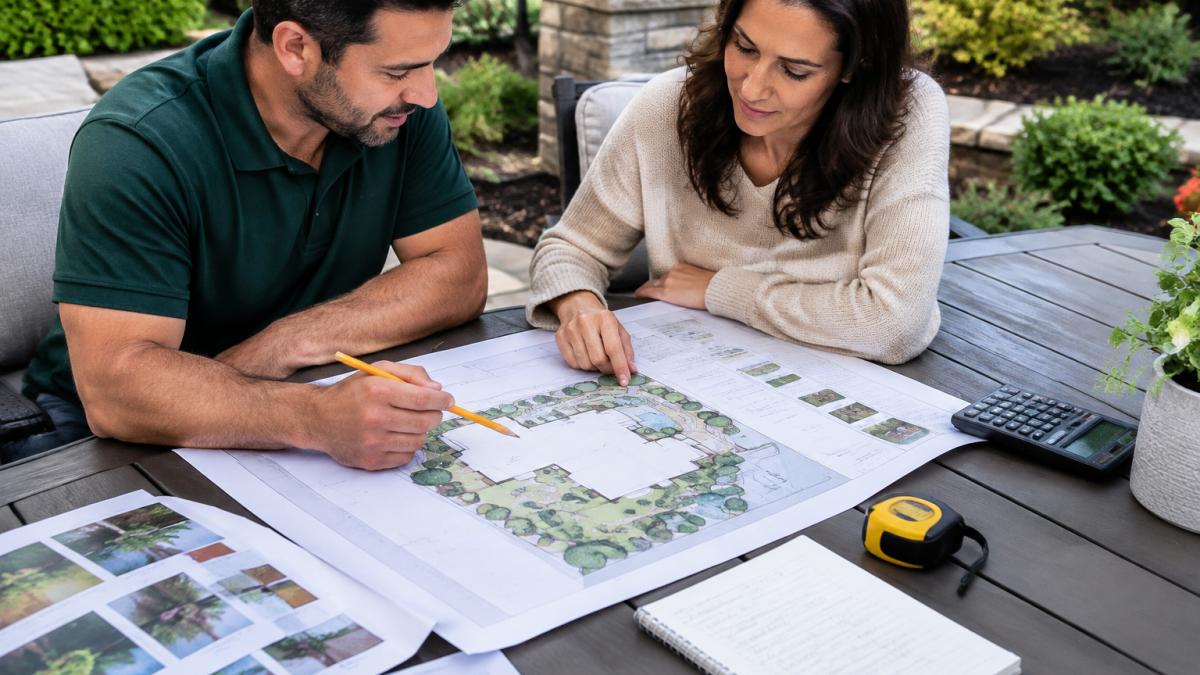
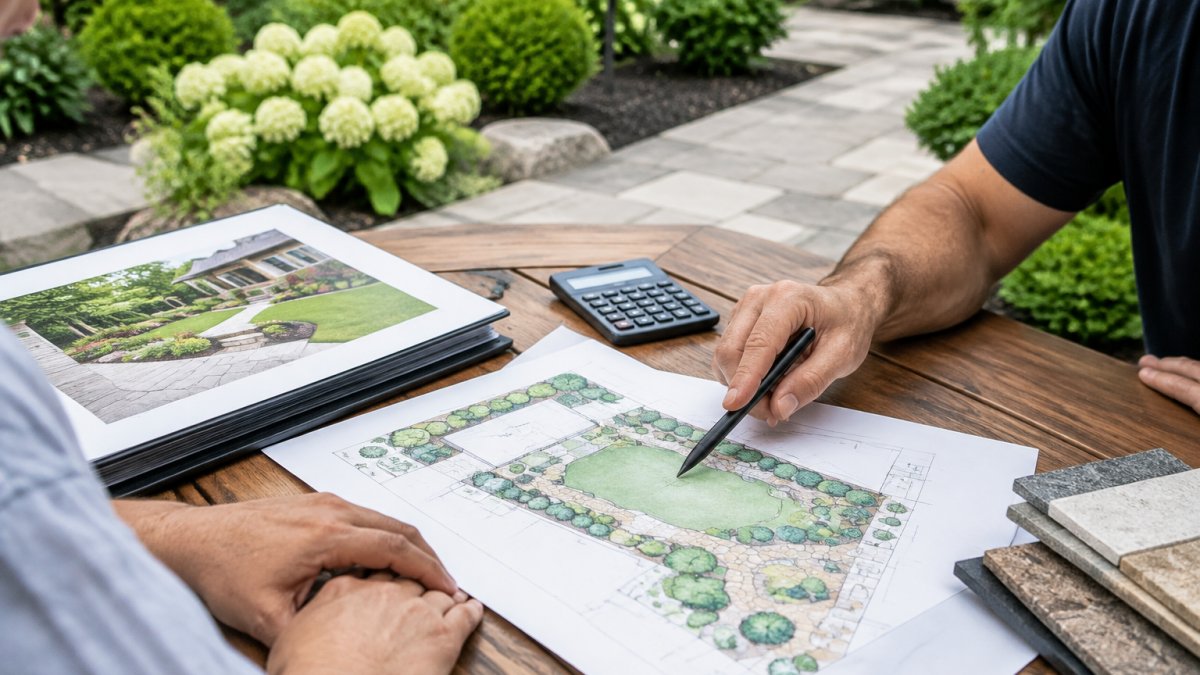
A complete deliverable usually includes a site plan, a planting plan with plant selection, material specifications, and a construction sequence. Higher tiers add 3D rendering, lighting layouts, and irrigation design.
Use this checklist when you compare proposals:
- Base site plan with property lines and existing features
- Planting plan naming species and sizes
- Hardscape dimensions and material specifications
- Grading and drainage notes
- Construction documents a builder can price
- Stated number of revision rounds included
- Deliverable format (PDF, CAD, printed set)
If a proposal does not list these, you are comparing prices for different products.
Landscape Design and Installation Cost: Where the Real Money Goes
Design is the cheap part. Landscaping installation costs dwarf design fees in almost every project, and that is where budgets get out of hand.
Materials, labor, permits, and equipment drive the total. A plan that specifies custom stone, mature plantings, and an outdoor living structure will cost several times more to install than its design fee. Phased projects help: build the hardscape and planting beds first, then add irrigation and lighting in a later season.
Watch out: a beautiful master plan you cannot afford to build in one season is a liability, not an asset. Ask your designer to price the plan in phases before you sign.
How to Use a Landscape Design Cost Calculator Without Getting Misled
Online landscape design cost calculators produce a number, not a quote. They work by multiplying a regional rate by your property size, then adjusting for scope. Treat the output as a starting range for budgeting conversations, never as a commitment.
The inputs that actually change the result are property size, project scope, and design complexity. If a calculator asks only for square footage, its answer will be wrong for any yard with drainage issues, slopes, or custom hardscape.
A better use: run the calculator, then ask two designers to explain the gap between its number and their proposal. The explanation tells you more about the designer than the price does.
Comparing Fee Models: Hourly, Flat Fee, and Per-Project Pricing
Designers price work in four common ways, and the model they choose tells you as much about the project as the number itself. Each model shifts risk differently between you and the designer, so the right question is not "which is cheapest" but "which model fits this scope."
| Fee Model | Typical Rate | Best For | Risk to You |
|---|---|---|---|
| Hourly | $50-$150/hour; landscape architects often $100-$250+ | Consultations, narrow questions, small scope changes | Open-ended total if scope drifts |
| Flat fee | $100-$300+ for consultations; $1,960-$7,220 for a comprehensive design | Defined single-deliverable work with clear boundaries | Scope disputes if deliverables are not written down |
| Per-area (per square foot) | Varies widely by region and complexity | Large properties or repetitive planting plans | Penalizes small, complex yards |
| Percentage of construction | Commonly a share of installed cost | Design-build projects where design and build are bundled | Fee grows as construction costs grow |
The trade-off is that the total is open-ended. Ask for a written estimate of hours before work begins, and ask what happens if the project runs long.
Flat fee suits defined single-deliverable work: a front-yard planting plan, a consultation with a written summary, a lighting layout. The trade-off is scope disputes. A flat fee is only as good as the deliverable list attached to it, so get the checklist in writing before you sign.
Per-area pricing is common on larger properties and repetitive planting plans, where the designer can estimate drafting time from square footage.
Percentage-of-construction pricing is common in design-build arrangements, where the design fee is expressed as a share of the installed cost. The advantage is alignment: the designer is invested in a buildable plan.
A common pattern is for designers to blend models, a flat fee for the base plan plus an hourly rate for revisions beyond the included rounds. That blend is not a red flag, but it must be disclosed.
Watch out: a low hourly rate can cost more than a higher flat fee if the project requires many site visits or revision rounds. Compare total estimated cost, not the headline rate.
How to Evaluate Quotes and Avoid Scope Surprises
Line up every quote against the same checklist, and the cheapest proposal usually stops looking cheap. The problem is that most homeowners compare the bottom-line number and never compare what is actually included. Use the worksheet below to normalize proposals before you decide.
Quote-comparison worksheet
- Deliverable list: site plan, planting plan, hardscape details, grading and drainage notes, construction documents
- Revision rounds included, and the cost of each additional round
- Site visits included, and whether travel is billed separately
- 3D rendering, lighting layout, and irrigation design, included or add-on
- Permit drawings and construction support, included or excluded
- Plan ownership and file format (PDF, CAD, printed set) after final payment
- Exclusions stated in writing
- Payment schedule tied to deliverables, not calendar dates
A common mistake is comparing a design-only quote against a design-build quote. They are not the same product. The design-build number includes installation labor and materials, so it will always look larger.
Ask each designer what is excluded. Exclusions are where scope surprises live: permit drawings, construction observation, plant procurement, and irrigation design are frequently left out of a base fee.
Ask how many revision rounds are included and what a second round costs. That single question separates transparent designers from the ones who bill surprises later.
Ask who owns the plan. Some designers retain ownership of drawings and license them for one build, which matters if you want to bid the work to multiple contractors or build in phases. Get ownership and file format in writing before you sign.
Ask what construction support is included. A plan is only as good as the designer's availability during build. Site visits during construction, contractor questions, and as-built adjustments are often billed hourly unless the proposal says otherwise.
Our advice: get the deliverable list in writing before you compare prices, and ask what a second revision round costs.
Request a Free Estimate from QEN Landscaping
Every property we quote gets the same treatment: a site assessment, a scope conversation, and a plan priced to what you actually want to build. We serve residential and commercial clients, with a single point of contact for constant communication.
Our team brings over 15 years of experience and customized solutions tailored to your property. We keep communication constant from initial design to final shrub installation.
Get started with QEN Landscaping and request a free estimate for your project.
Frequently Asked Questions
What does a landscape designer charge?
Designers commonly quote either an hourly rate or a flat project fee. Pricing depends on scope, site conditions, and whether the work includes construction documents or installation oversight. Request a free estimate from QEN Landscaping for a quote specific to your property.
How much does landscape design cost per square foot?
Per-square-foot pricing is less standardized than hourly or per-project fees, because designers price complexity, not just area. A flat, open yard with simple planting beds costs far less per square foot than a sloped site needing topographical grading, utility routing, or retaining walls. When you request quotes, ask for the per-square-foot rate and the site conditions it assumes. That comparison reveals whether a low number reflects a smaller scope rather than a better deal.
Does landscape design cost include installation?
Usually not. Design fees generally cover design services only, and the cost gap between design-only and design-build work can be wide. Installation adds labor, materials, hardscape construction, permits, and plant costs on top of the design fee. Confirm in writing whether your designer's fee includes construction documents, site visits during installation, or none of the above.
Is it worth paying a landscape designer?
A professional design reduces costly mistakes: wrong plant selection for your light and soil, drainage that pools water against the foundation, and hardscape that fails inspection. A master plan also lets you phase a project over several years without redoing work. The design fee is a small share of total project cost, and a clear plan helps contractors bid accurately. For a yard renovation involving grading, irrigation, or hardscape, the plan usually pays for itself in avoided rework.
Is there a difference between a landscape architect and a landscape designer?
Yes. Landscape architects are licensed, and in most states that requires a degree plus exams and supervised experience. They can stamp construction documents for permits and handle complex grading, drainage, and structural work. Landscape designers handle planting plans, material selection, and residential layouts without a license. Designer rates and registered architect rates can differ considerably. Match the credential to your project's complexity and permit requirements.
The numbers in this guide give you a budget range. Your property gives you the real answer. Request a free estimate from QEN Landscaping and get a design scope priced to your yard, your goals, and your timeline.