 Comparison
Is Robotic Lawn Mowing Worth It for Large Properties?
Last Updated: November 9, 2026
Quick Summary
Robotic lawn mowing is worth it for large properties only when the time and labor saved clearly outweigh the purchase price and ongoing ownership costs. Size the robot at 1.3 to 1.5 times your usable acreage, and if usable lawn exceeds one machine's daily window, two smaller robots usually beat one oversized unit.
- Most residential robot mowers are rated for roughly 1 to 1.5 acres, while commercial-grade models can be rated for 5 acres or more.
- Mid-range models for half-acre lawns run USD 1,200 to USD 2,000, while premium wire-free GPS units reach USD 3,000 to USD 5,000.
- A documented 60-day trial on a 1.5-acre lot reported roughly 1.1 million square feet mowed and potentially 195 hours saved.
- Robot mowers work on hills only within their rated slope and struggle on rough, wet, or thick ground.
- Run the cost comparison over three, five, and seven years, since payback depends on whether the alternative is paid labor or your own time.
Table of Contents
- The Real Math Behind Robotic Lawn Mowing on Large Properties
- How Many Acres Can a Robot Lawn Mower Cover?
- The Best Robotic Lawn Mower for Large Lawns: What to Look For
- Do Robot Lawn Mowers Work on Hills and Uneven Terrain?
- Robot Mower vs. Traditional Mower: Time, Cost, and Cut Quality
- Installation, Security, and the Human Workload Nobody Mentions
- Request a Free Estimate for Professional Grounds Care
- Frequently Asked Questions
The Real Math Behind Robotic Lawn Mowing on Large Properties
Robotic lawn mowing is worth it for large properties only when the time and labor saved clearly outweigh the purchase price and ongoing ownership costs. That threshold is higher than most buyers expect.
The market is moving fast. Straits Research's robotic mower market analysis values the category at USD 2.68 billion in 2026 and projects USD 7.48 billion by 2034, a 13.67% compound annual growth rate. Growth does not equal fit, though. At QEN Landscaping, we have watched homeowners and property managers weigh these machines against crews, and the deciding factor is almost never the spec sheet. It is the hours.
Here is the honest math. A robotic mower that runs daily trades one long weekly cut for many short ones. That protects lawn health but spreads the work across the calendar, which only pays off if the machine genuinely covers your acreage. Below, we break down capacity, terrain, true cost, and the human workload nobody mentions.
How Many Acres Can a Robot Lawn Mower Cover?
Most residential robot mowers are rated for roughly 1 to 1.5 acres, while commercial-grade models can be rated for 5 acres or more, according to Automated Outdoor Solutions' capacity guidance. Those ratings assume flat ground, unobstructed lawn, and daily mowing. Real properties rarely match the brochure, and on large grounds the gap between rated and delivered acreage is where most buyers get surprised.
The useful way to plan capacity is to work backward from mowing hours, not from the spec sheet. A robot cuts a narrower swath than a riding mower and moves at a walking pace, so its real output is a function of effective cutting width, ground speed, and the hours per day it can actually run.
Three property factors shrink rated capacity fastest:
- Fragmentation: every separate zone adds travel time between areas and often a return trip to the dock. A lawn split into several zones can lose a meaningful share of its rated output to transit between them.
- Narrow passages: a gate or strip narrower than the machine's effective cutting width forces manual trimming or a second pass, and tight gaps slow navigation.
- Obstacles and boundaries: beds, trees, ponds, and outbuildings each add a perimeter the robot must respect, and dense obstacle fields force more turns and more missed strips.
A practical capacity plan starts with usable lawn, not total lot size. Measure the actual grass, subtract beds, structures, driveways, and woodland, then plan for a mower rated comfortably above that figure. As a rule of thumb, size the robot at 1.3 to 1.5 times your usable acreage to absorb fragmentation and seasonal growth.
On larger properties, the question shifts from which robot to how many. If usable lawn exceeds what one machine can cover in its available daily window, often 8 to 12 hours of run time including charge-and-resume cycles, the answer is usually two smaller robots rather than one oversized unit.
Available mowing hours matter as much as acreage. A property with long shade periods, irrigation schedules, or public-facing hours that restrict when a robot can run effectively reduces the daily window and therefore the acreage one machine can hold. Before committing, map your zones, count your obstacles, and calculate usable lawn against a realistic daily run window.
The Best Robotic Lawn Mower for Large Lawns: What to Look For
The best robotic lawn mower for large lawns combines wire-free GPS navigation, multi-zone management, and enough runtime to finish the property without constant babysitting. Everything else is secondary.
Four features decide whether a machine survives a large property:
- Wire-free navigation: RTK-GPS or LiDAR mapping avoids burying hundreds of feet of boundary wire. Models like the Segway Navimow X350 and Ecovacs Goat A3000 Pro lean on this approach.
- Multi-zone scheduling: the app must let you split acreage into zones with separate schedules and cut heights.
- Runtime and charging: a high-capacity battery plus automated charge-and-resume keeps daily coverage on track.
- Slope rating: the manufacturer's maximum grade tells you more about real-world fit than any marketing claim.
Budget matters too. Mid-range models for half-acre lawns run USD 1,200 to USD 2,000, while premium wire-free GPS units for large properties reach USD 3,000 to USD 5,000, per Lawnmowers.com's 2026 buying guide. Spend on navigation and slope rating before you spend on app extras.
Do Robot Lawn Mowers Work on Hills and Uneven Terrain?
Robot mowers work on hills only within their rated slope, typically modest grades, and they struggle on rough, wet, or thick ground. Traction and navigation, not cutting power, are the usual failure points.
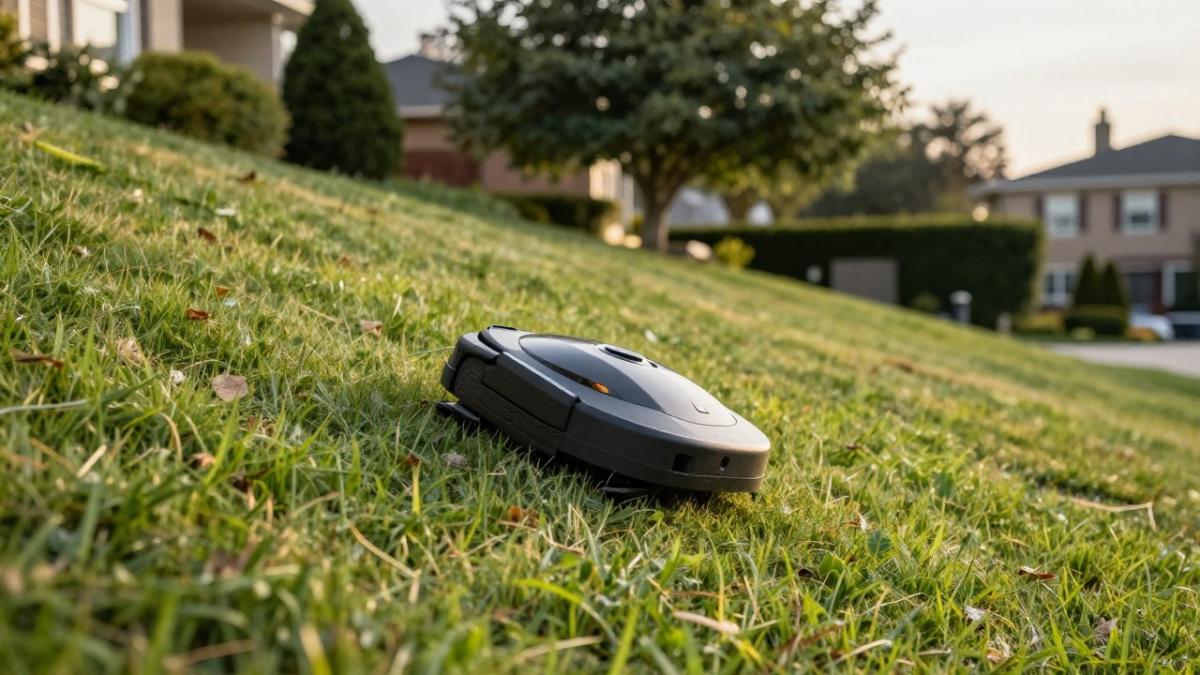
Matching the machine to the land matters: check each model's rated slope and avoid pushing a light-duty unit past its limit.
Watch out: wet or thick grass defeats most robotic mowers. TerraMow's field notes point out that traditional mowers still work better on big or bumpy properties, and that robots have more trouble with wet, heavy growth. On a large, uneven lot, plan for a machine that can handle the worst section, or keep a crew for it.
Robot Mower vs. Traditional Mower: Time, Cost, and Cut Quality
A robot mower wins on time and consistency; a traditional riding or zero-turn mower wins on raw speed and rough-ground capability. The right pick depends on which of those you value more, and on a like-for-like cost comparison most buyers never run.
| Factor | Robot Mower | Traditional Mower |
|---|---|---|
| Upfront cost | USD 1,200-5,000 plus installation | Lower per unit, higher fuel and labor |
| Time per session | Daily short cuts, hands-off | One long weekly cut, hands-on |
| Cut quality | Consistent, mulching, frequent | Good, but clumps in tall grass |
| Terrain limits | Rated slopes only | Handles rough, wet, thick ground |
| Labor | Near zero once installed | Every cut needs an operator |
Cut quality favors the robot on maintained turf. The tradeoff is speed: a robot cuts a narrower swath per pass, so it takes longer than a person to cover the same ground, as Consumer Reports' 2026 testing notes. Frequent mowing is the real prize. University of Florida research found robotic mowers can maintain and even improve lawns, including St.
Comparing cost over several years, rather than one season, gives the most useful picture. A transparent total cost of ownership for a large property includes:
- Purchase and installation: the robot itself plus dock, boundary mapping, and any trenching or wire work. Wire-free GPS models skip the trench but still need a dock and a mapped perimeter.
- Repairs and replacement parts: blades, wheels, and sensors wear; budget for annual blade sets and occasional sensor or drive repairs.
- Batteries: lithium packs degrade and typically need replacement within a few seasons, which is a real line item on a large property where the machine runs daily.
- Electricity: charging a robot is a small but nonzero cost, and it rises with acreage and run hours.
- Maintenance labor: blade changes, debris clearing, seasonal schedule adjustments, and troubleshooting.
- Operator labor for the alternative: the crew hours or your own weekend hours a traditional mower requires, priced at a realistic rate.
Run that comparison over three, five, and seven years. The payback period depends heavily on whether the alternative is paid labor or the owner's own time. Fuel, oil, belts, and tune-ups for a riding mower add up too, and those costs belong on the traditional side of the ledger.
Watch out: the payback calculation flips quickly if the robot cannot cover the property without frequent manual rescue. Every stall, stuck wheel, or missed zone adds operator time back into the robot column and erodes the labor savings that justify the purchase. Model the human workload honestly before you trust the payback number.
Installation, Security, and the Human Workload Nobody Mentions
Installation and upkeep are the hidden line items. Wire-free models skip the boundary-wire trench, but every robot still needs a charging dock, a mapped perimeter, and periodic blade changes and app checks.
The human workload is smaller than mowing, not zero. Someone maps zones, adjusts schedules seasonally, clears debris, and retrieves the machine when it stalls. On a large property, expect occasional manual intervention at obstacles and narrow passages.
Security and access deserve a plan. A robot left out is a theft target, and GPS-dependent models need a clear sky view to navigate reliably. Set geofencing alerts, keep the dock out of public view, and confirm the machine's anti-theft lock works before you rely on it.
A real-world test shows the upside. One property owner ran a robotic mower on a 1.5-acre lot for 60 days, and the documented trial reported roughly 1.1 million square feet mowed and potentially 195 hours of mowing time saved. That is the payoff, provided the property suits the machine.
Request a Free Estimate for Professional Grounds Care
Robotic mowing is worth it on large properties when the lawn is manageable, the terrain is within rating, and the hours saved justify the cost. When acreage, slopes, or wet ground push past a robot's limits, a professional crew remains the reliable answer.
That is where we come in. QEN Landscaping brings over 15 years of experience serving both residential and commercial clients, with customized solutions built around your property's layout. We keep communication constant until the job is done. If you are weighing automation against professional care, read our professional lawn maintenance services NJ guide to see what full-service grounds care covers.
Get started with QEN Landscaping and keep your grounds looking their best, season after season.
Frequently Asked Questions
What are the downsides of robotic lawn mowers on large properties?
Robotic mowers can struggle with wet or thick grass, and they cut a narrower swath than a riding mower, so they may take longer per pass. Large or uneven properties may need multiple zones or a fleet of mowers. Upfront costs run from about $1,200 to $5,000 depending on model and capacity, and battery life and charging time limit daily coverage. Some models also require a clear sky view for GPS navigation.
How many acres can a robot lawn mower cover?
Residential and commercial robotic mowers are rated for different acreages, so check the specifications of the model you are considering. For a half-acre lawn, contact QEN Landscaping through our website for current pricing or a quote. If your property exceeds the rated capacity, you will need multiple zones or a larger commercial unit to avoid constant manual intervention.
Do robot lawn mowers work on hills?
Many robotic mowers handle moderate slopes, but steep or uneven terrain can cause traction loss or navigation errors. Models with all-wheel drive may handle steep grades and rough ground better, so check each model's rated slope. For hillside properties, check the maximum slope rating and consider a wire-free GPS model with robust obstacle avoidance. Check the mower's maximum slope rating against your property's grade.
Is a robotic mower worth it compared with a traditional mower for large lawns?
It depends on your time and labor costs. A robotic mower can save hours of mowing time each week, but the upfront cost and ongoing maintenance must be offset by those savings. If you value your weekends or pay for labor, the payback period may be short; if not, a traditional mower may be more cost-effective.
How long does a robotic lawn mower battery last?
Battery life varies by model and lawn size. Battery life varies by model and lawn size, so check the run time and charging specifications for the model you are considering. For multi-acre properties, consider a model with automated charging and resume functionality to minimize downtime.