 Ultimate guide
Irrigation System Installation Cost Breakdown: 2026 Guide
Table of Contents
- Average Cost of Sprinkler System per Square Foot
- Irrigation Installation Cost Breakdown by System Type
- Factors Affecting Irrigation Installation Price
- Labor, Materials, and Permit Fees: What You Are Paying For
- Zone Pricing, Smart Controllers, and Long-Term Operating Costs
- DIY Installation vs. Hiring a Professional Contractor
- How Long Does Sprinkler Repair Take on Average?
- Conclusion
- Frequently Asked Questions
Last Updated: September 21, 2026
Average Cost of Sprinkler System per Square Foot
Any honest irrigation system installation cost breakdown starts with a warning: square-foot pricing is a rough filter, not a quote. The wide ranges homeowners find online exist because no two yards are priced the same way. At QEN Landscaping, we have delivered customized, top-tier landscaping solutions for over 15 years, and per-square-foot figures only work as a starting point for budgeting, not a final number.
Irrigation system installation cost breakdown is the process of separating a sprinkler project into its component costs: system design, trenching, pipe materials, heads and valves, labor, permits, and long-term maintenance. A single blended price hides all of that.
Why Square Foot Pricing Is Only a Starting Point
Square footage tells you how much pipe and how many heads a yard needs, but nothing about trenching difficulty, water pressure, soil type, or zone count. A flat, open half-acre and a half-acre full of mature trees, retaining walls, and established beds can carry wildly different installation costs despite identical measurements.
Treating a per-square-foot phone estimate as a real budget is a common mistake. Reputable contractors price after a site walk, because site conditions change the labor line more than size does.
Irrigation Installation Cost Breakdown by System Type
System type is the single biggest driver of price. In-ground systems and drip irrigation solve different problems, and most residential properties use a mix of both.
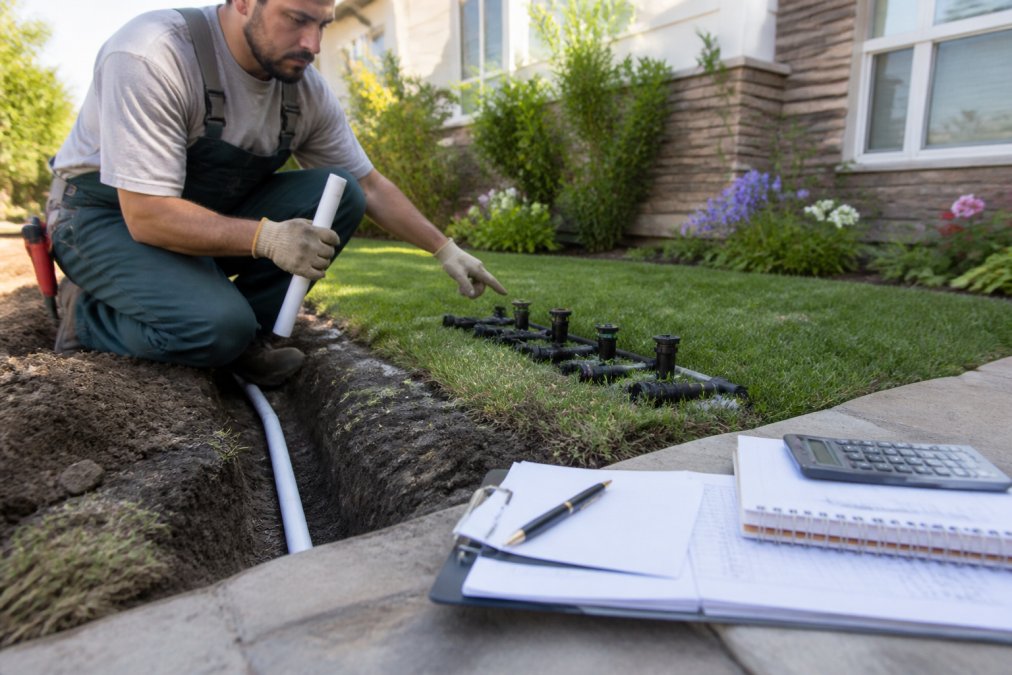
In-Ground Systems vs. Drip Irrigation
In-ground systems use buried PVC piping and pop-up heads for lawns. They involve more trenching and higher material costs, but handle large turf areas efficiently.
Drip irrigation delivers water directly to plant roots through flexible tubing and emitters. Trenching is shallower, and it suits garden beds, shrubs, and hydro-zoning plantings by water need.
| System Type | Best For | Main Cost Drivers | Maintenance Profile |
|---|---|---|---|
| In-ground sprinkler | Lawns, large turf | Trenching, PVC piping, valve boxes | Higher, heads need seasonal checks |
| Drip irrigation | Beds, shrubs, planters | Tubing, emitters, filtration | Lower, emitters can clog |
| Hybrid | Most residential yards | Combination of both | Moderate, two subsystems to service |
Factors Affecting Irrigation Installation Price
The factors affecting irrigation installation price fall into three groups: what is underground, what is above it, and what the water supply can deliver. Size sets the floor; these three set the actual number.
Soil Type and Trenching Labor
Soil type is the most under-quoted cost driver in residential irrigation. Trenching is priced by the linear foot, but the labor hours behind that foot swing widely by ground condition:
- Sandy or loamy soil, a walk-behind trencher cuts cleanly and the trench holds its shape. This is the fastest, cheapest condition to work in.
- Heavy clay, the trencher bogs down, walls slump, and crews often finish runs by hand. Expect noticeably more labor hours per foot and more spoils to haul off.
- Rock, caliche, or buried debris, a trencher may be useless. Rock requires a rock saw or hand digging with a pry bar, and that is where per-foot pricing can multiply.
- Compacted fill in newer developments, common in recently graded subdivisions. It drains poorly and resists cutting, behaving like clay even when the native soil is workable.
Soil also changes the hardware. Clay drains slowly, so heads need matched precipitation rates and shorter cycles to avoid runoff.
Water Source, Pressure, and Backflow Protection
Where the water comes from changes the equipment list before a single trench is dug.
What Above-Ground Conditions Add
Mature trees mean root avoidance and possible hand trenching. Retaining walls, patios, and driveways mean boring under hardscape. Established beds mean drip lines threaded around existing plantings. Each converts machine work into hand work, and hand work is billed by the hour.
Labor, Materials, and Permit Fees: What You Are Paying For
Labor is usually the largest single line in any irrigation system installation cost breakdown. It covers system design, excavation, trenching, pipe assembly, head placement, wiring the timer, and pressure testing. Rates vary by region and season, and skilled irrigation work is not the place to chase the lowest hourly number.
Zone Pricing, Smart Controllers, and Long-Term Operating Costs
Zone count drives both installation and operating cost, and it is the number most homeowners never see itemized. A zone is a group of heads that runs together based on available pressure and coverage. More zones mean more valves, wire, trenching, and labor, but they also allow hydro-zoning so turf and beds are watered on different schedules.
How to Read a Per-Zone Price
A per-zone figure is only useful if you know what is inside it. A complete zone typically includes:
- One remote-control valve and its valve box
- The lateral pipe run from the valve to the heads
- The heads, nozzles, and swing risers for that zone
- The low-voltage wire back to the controller, plus a wire splice
- The labor to trench, assemble, wire, and pressure-test the run
Smart Controller ROI: The Long-Term Saving Most Quotes Ignore
A smart controller is the clearest long-term saving in the whole system, and the angle most installation guides skip. A standard timer runs a fixed schedule no matter the weather. A smart controller adjusts run times based on local evapotranspiration (ET) data, weather feeds, or soil-moisture sensors, and paired with a rain sensor it stops cycles when rain is coming.
Winterization: The Recurring Cost Quotes Leave Out
In cold-winter regions, winterization is not optional and not a one-time expense. It means blowing compressed air through the lines before the first hard freeze so trapped water does not expand and crack pipe, valves, or heads. Budget it annually alongside spring start-up.
A typical annual ownership cycle looks like this:
- Spring start-up, pressurize the system, check each zone for broken heads and leaks, replace nozzles, and reset the controller schedule.
- Mid-season check, head adjustment and coverage correction after turf grows in and plantings fill out.
- Fall winterization, isolate the water supply, drain or blow out each zone, and shut down the controller.
- As-needed repair, broken heads, stuck valves, and line breaks, which are the unpredictable line item.
Maintenance and Long-Term Operating Costs
Maintenance costs are the part most quotes leave out. Annual service typically includes head adjustments, nozzle replacement, valve checks, and seasonal start-up and shutdown. Ongoing operating costs are water, electricity for the controller and any booster pump, and periodic replacement of heads, emitters, and valves as they wear. Drip emitters clog and need flushing; pop-up heads get clipped by mowers.
DIY Installation vs. Hiring a Professional Contractor
DIY irrigation installation saves on labor but shifts real risk onto you. The work involves trenching to correct depth, assembling pipe to hold pressure, wiring valves and the controller, and getting zone coverage right so you are not watering the sidewalk.
The tasks that most often go wrong on DIY projects:
- Zone design that leaves dry spots or over-spray
- Trench depth too shallow, leading to freeze damage
- Backflow protection installed incorrectly or omitted
- Controller wiring that trips the breaker or fails to run zones
- No pressure test before backfilling
How Long Does Sprinkler Repair Take on Average?
Most sprinkler repairs take one to three hours. A broken head, clogged nozzle, or stuck valve is usually a same-day fix. Larger jobs, such as locating a buried line break or replacing a zone valve, can run a full day once excavation and testing are included.
Conclusion
The hardest part of budgeting irrigation is that every yard prices differently, and a single per-square-foot figure will never capture trenching difficulty, water pressure limits, or winterization costs. A line-by-line breakdown is the only way to compare quotes fairly and avoid surprises.
Frequently Asked Questions
What is the average cost to install an irrigation system?
There is no single number because irrigation installation cost depends on your lawn size, soil type, water pressure, and the number of zones you need. A small yard with three zones costs far less than an acre with eight or more zones. Reputable contractors provide a line-item estimate after a site visit so you can see exactly what you are paying for, from trenching to backflow preventer installation.
What factors influence the total cost of a sprinkler system installation?
The biggest factors are lawn size, landscaping complexity, soil type, and water pressure at your source. Hard clay soil may require more excavation, while low water pressure can mean adding a booster pump. Other cost drivers include permit fees, backflow preventer requirements, the number of zones, nozzle types, and whether you choose a smart controller or a basic automatic timer.
Are there ongoing maintenance costs after the initial installation?
Yes. Budget for annual maintenance costs such as spring start-up, fall winterization, head adjustments, and occasional valve or pipe repairs. Winterization is essential in colder regions to prevent freeze damage. Smart controllers and rain sensors can reduce water waste, but they still need occasional firmware updates and seasonal reprogramming to stay effective.
Does an irrigation system add value to a house?
A well-installed system can add value by keeping your lawn healthy and reducing manual watering time. Buyers often see a maintained landscape as a sign of overall property care. The return depends on your local market and how well the system is maintained. Pairing irrigation with hydro-zoning and a smart controller tends to make the system more attractive to future buyers.