 How-to
7 Fixes When Grass Turns Yellow After Fertilizing
Last Updated: November 17, 2026
Quick Summary
Flush the yellow grass with deep, controlled watering to push excess fertilizer salts below the root zone. Water the affected areas for 20 to 30 minutes, wait an hour, then repeat once more, and skip mowing for a few days. Hold off on more fertilizer until you see new growth.
- Confirm fertilizer burn first: scorched tips in spreader-pattern stripes within days of applying point to burn.
- Light sprinkling makes burn worse because it dissolves granules without moving salts down.
- Most lightly burned lawns show new growth in 2 to 4 weeks; severe burn can take 6 to 8 weeks.
- Check the crown for green tissue and run the tug test instead of judging recovery by color.
- Prevent burn by calibrating your spreader and spreading in two passes at half the rate each.
Table of Contents
- Why Grass Turns Yellow After Fertilizing
- Will Fertilizer Burn Grass If Not Watered?
- How to Save Grass After Fertilizer Burn
- How Long Will Grass Grow Back After Fertilizer Burn?
- Best Fertilizer for Yellow Grass (and What to Skip)
- Preventing Fertilizer Burn Next Time
- When to Call a Professional
- Request a Free Estimate From QEN Landscaping
- Frequently Asked Questions
Why Grass Turns Yellow After Fertilizing
If your lawn turned yellow after fertilizing, you are likely looking at fertilizer burn, salt damage, or an application mistake.
Fertilizer burn happens when too much nitrogen sits against the grass blades and roots. The salts pull moisture out of the turf.
Many guides tell you to water immediately and stop there.
Maryland's Lawn Fertilizer Guide for Homeowners puts it plainly: forcing a dormant lawn to green up with fertilizer can damage the grass, and watering dormant grass is unnecessary.
Before you grab the hose, know what you are dealing with.
Will Fertilizer Burn Grass If Not Watered?
Yes. Fertilizer can burn grass if it is not watered in, especially fast-release nitrogen products. The granules sit on the blades and release a concentrated dose of salts.
Granular fertilizer is the biggest offender.
Liquid fertilizer can cause the same problem when it is over-applied or sprayed unevenly. Concentrated patches burn fast.
A few conditions make burn more likely:
- Applying on a hot, dry day
- Skipping the watering-in step
- Over-applying in one pass
Watering after application is not optional, it turns fertilizer from a risk into a benefit.
How to Save Grass After Fertilizer Burn
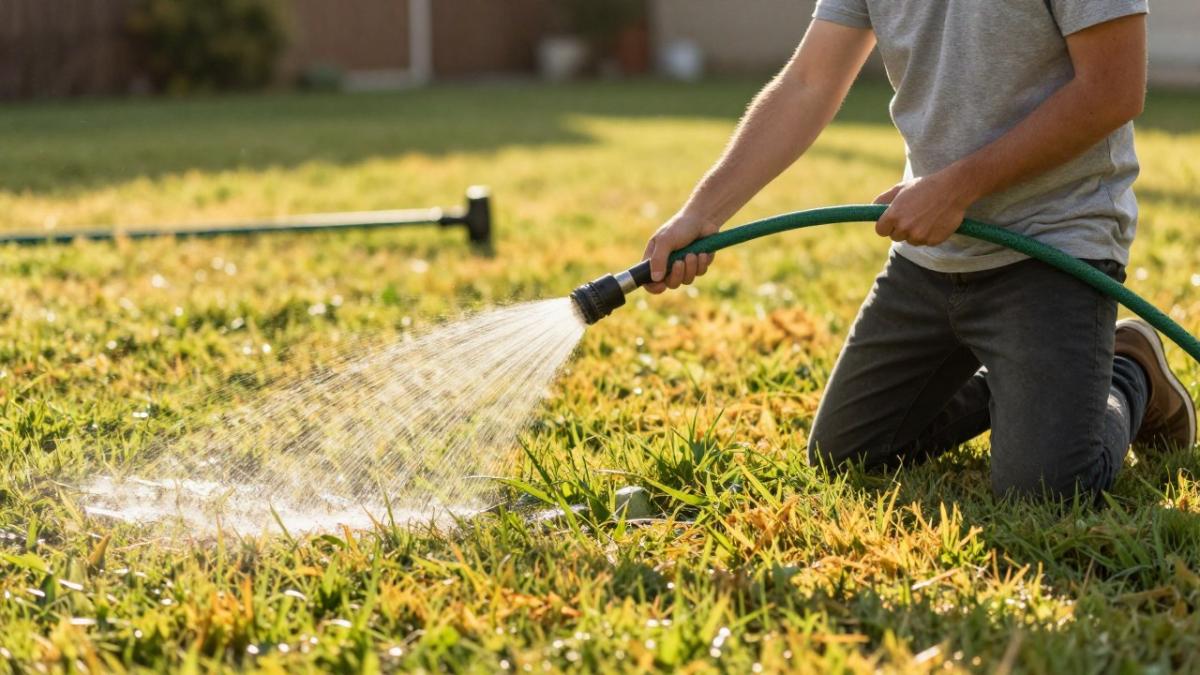
The fix for yellow grass after fertilizing is controlled, deep watering that flushes excess salts below the root zone. Do it in the right order and most lawns bounce back.
Step 1: Diagnose Before You Water
Start by confirming it is actually fertilizer burn. Yellowing has several causes, and they need different fixes.
Fertilizer burn shows up as brown or scorched tips, often in stripes or patches that match your spreader pattern. It appears within days of applying.
Drought stress leaves footprints that stay visible and blades that fold instead of standing up. Dormancy turns the whole lawn an even tan color in cold or dry seasons. Disease brings irregular spots, rings, or fuzzy growth. Nutrient deficiency yellows older blades first, usually evenly.
Use this quick checklist:
- Did I fertilize in the last 7 days?
- Are the patches in stripes or spreader patterns?
- Do the tips look scorched and brown?
If you checked the first three boxes, fertilizer burn is the likely cause. Move to Step 2.
Step 2: Flush the Fertilizer Salts
Water deeply to push the salts past the roots. Light sprinkling makes it worse because it dissolves the granules without moving them down.
Follow this sequence:
- Water the affected areas for 20 to 30 minutes.
- Wait an hour so the water soaks in.
- Repeat once more to push salts deeper.
- Skip mowing for a few days to reduce stress.
- Hold off on more fertilizer until you see new growth.
Adjust for your soil. Sandy soil drains fast, so you may need a second round.
Watch out: overwatering on clay soil can drown roots and cause runoff into storm drains. Water in cycles, not one long soak.
Step 3: Handle Spills, Granules, and Hard Surfaces
Spills and piles need special handling. A concentrated pile of granules will burn straight through the turf.
- Sweep up dry spills before adding water.
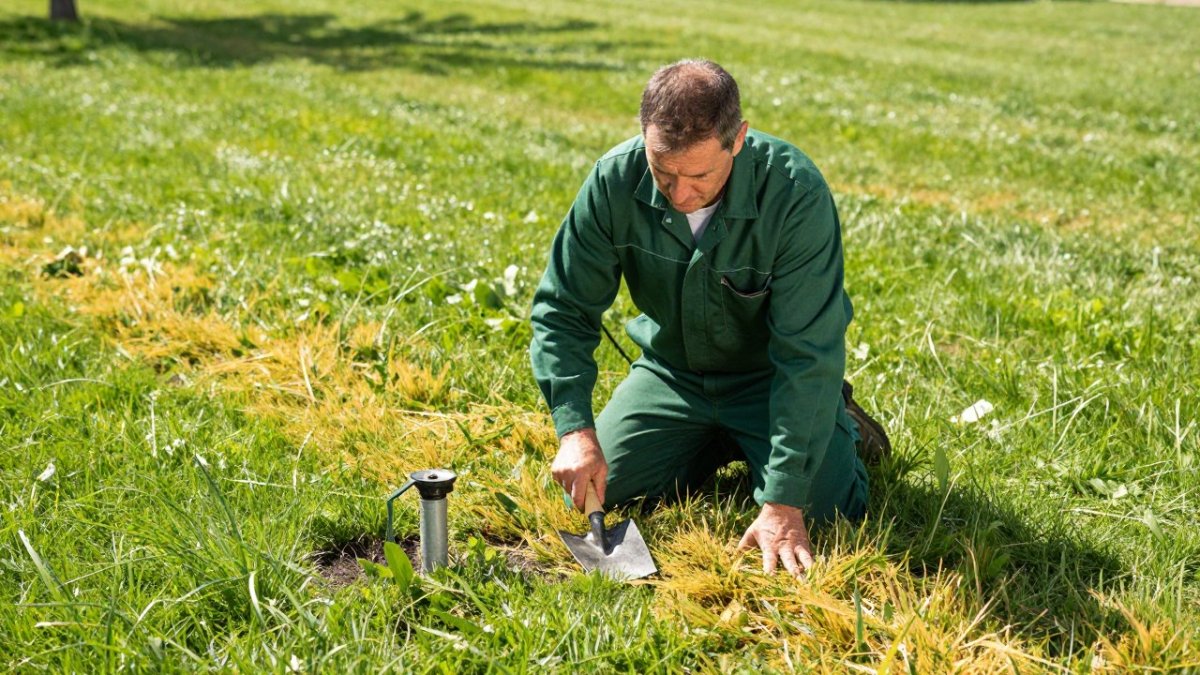
- Dig out heavy piles with a shovel and discard them.
- Flush the spot with several deep waterings over a few days.
Keep pets and children off treated areas until the granules dissolve and the lawn dries. Fertilizer granules look like kibble to a curious dog. Rinse runoff away from storm drains to protect local waterways.
Here is the flushing sequence the article recommends, plus the soil adjustments to make along the way.
| Step | What to do | Time or frequency |
|---|---|---|
| 1 | Water the affected areas | 20 to 30 minutes |
| 2 | Wait so the water soaks in | 1 hour |
| 3 | Repeat the deep watering | Once more |
| 4 | Skip mowing to reduce stress | A few days |
| 5 | Hold off on more fertilizer | Until new growth appears |
| Sandy soil | May need a second round | Drains fast |
| Clay soil | Water slower and watch for pooling | Holds water |
| Slopes | Water in short bursts | Soaks in instead of running off |
How Long Will Grass Grow Back After Fertilizer Burn?
Recovery depends on how much of the plant survived.
Instead of watching the calendar, watch the plant.
Days 1 to 3 after flushing. Yellowing may look slightly worse before it looks better, because damaged tissue keeps dying back. What you want is no new browning spreading outward. If the burn line is still advancing, the salts are still active and you need another deep watering cycle.
Days 4 to 7. Look at the base of the plants, not the tips.
Weeks 2 to 3. New growth should be pushing up through the brown.
Weeks 4 to 6. Run the tug test.
Weeks 6 to 8. By this point, live crowns should have filled most of the thinned areas.
Watch out: do not judge recovery by color alone in the first two weeks. A uniformly tan lawn can still be alive at the crown, and a green lawn can have dead crowns underneath. The crown check and tug test are more reliable than blade color.
Best Fertilizer for Yellow Grass (and What to Skip)
The best fertilizer for yellow grass is a slow-release, balanced product applied at the correct rate. Slow-release nitrogen feeds the lawn gradually instead of dumping salts all at once.
What to look for:
- Slow-release nitrogen on the label
- A soil test to confirm what is actually missing
- The right spreader setting for your product
- Even coverage in two passes, half the rate each time
What to skip:
- Fast-release nitrogen on a hot day
- High-nitrogen "quick greening" products on stressed turf
- Applying more to fix yellowing that is not a nutrient problem
A soil test tells you the real story. If your soil pH is off, no amount of fertilizer will fix yellow grass. Correct the pH first, then feed.
Preventing Fertilizer Burn Next Time
Prevention comes down to three habits: the right rate, even spreading, and watering-in. For a broader look at putting these habits into a complete care routine, see our professional lawn maintenance services guide. The part most guides skip is how to hit the right rate with the spreader you own, because uneven coverage, not just over-application, produces the striped burn patterns described earlier.
Calculate the Rate Before You Fill the Hopper
The bag states a rate in pounds of product per 1,000 square feet. Measure your lawn area first, breaking an irregular yard into rectangles and triangles.
Next, confirm the nitrogen load. The first number on the fertilizer label is the nitrogen percentage (Fertilizer bag numbers reveal nutrient content). A 4-pound application of a 30-0-0 product delivers about 1.2 pounds of actual nitrogen per 1,000 square feet, which is already at the high end for a single pass on many cool-season lawns.
Calibrate the Spreader
Do not trust the setting printed on the bag, it is a starting point, not a guarantee, and it varies by spreader model and walking speed. Calibrate with a simple test:
- Mark off a test strip of known area, such as 10 feet by 50 feet (500 square feet).
- Weigh the product you put in the hopper.
- Run the spreader at your normal pace over the strip at the bag's suggested setting.
- Weigh what is left and subtract to find how much you applied.
- Compare that to the target for 500 square feet. If you applied too much, lower the setting or walk faster; if too little, raise it.
Repeat until the test strip matches the target within a small margin. Write the setting and your walking pace on the bag so you can repeat it next time.
Spread in Two Passes
Split the total rate in half and apply in two directions, one pass front-to-back, one side-to-side. This crosshatch pattern fills gaps and averages out overlap. Overlapping full-rate passes in the same direction is the most common cause of striped burn, because overlap zones receive double the product.
Watch out: spreader pattern defects cause burn even at the correct rate. If your spreader throws more to one side, the heavy side scorches while the light side underfeeds.
Time the Application and the Watering-In
Apply when the lawn is actively growing, not dormant, and avoid the hottest part of a dry day. Water in right after applying, enough to dissolve the granules and move them into the soil, but not so much that it runs off.
Finally, let a soil test set the program. If pH is off, no amount of fertilizer will fix yellow grass, and adding more product to a lawn that is not deficient only raises burn risk.
When to Call a Professional
Call a professional when the damage is widespread, the patches are dead, or you cannot tell what caused the yellowing. A pro can run a soil test, check for disease, and reset your whole program.
Signs it is time to get help:
- Large dead patches that will not recover
- Yellowing that returns after every feeding
- Drainage or runoff problems you cannot solve
- A commercial property where appearance matters every day
QEN Landscaping serves residential and commercial clients and offers tailored solutions. If you want a broader look at recovery steps, our guide on core aeration for fall explains how aeration helps damaged turf rebound.
Request a Free Estimate From QEN Landscaping
Yellow grass after fertilizing is fixable, but guessing wastes time and water.
QEN Landscaping brings over 15 years of experience, with customized solutions and constant communication until the job is done. We serve residential and commercial clients.
Get started with QEN Landscaping and give your lawn the care it deserves.
Stop guessing why your lawn turned yellow and let a trained eye diagnose it.
Frequently Asked Questions
Can grass recover after turning yellow?
Yes, in most cases. Yellow grass from fertilizer burn or drought stress usually recovers if the roots are still alive. Flush the affected area with about 1 inch of water, then water deeply once a week and stop all fertilizer for at least 4 to 6 weeks. Watch for new green shoots from the center of the damaged patch, which is the clearest sign the turf is bouncing back. Patches that stay brown and pull up easily may need reseeding.
How can you tell if yellow grass has fertilizer burn?
Fertilizer burn shows a pattern: yellow or brown scorched tips on grass blades, streaks that follow spreader passes, and damage concentrated where granules piled up. It typically appears 1 to 3 days after application, especially with fast-release nitrogen. Drought stress looks uniform across the lawn, disease shows irregular circles or spots, and nutrient deficiency yellows the whole blade evenly. Check the pattern first, then water accordingly.
Should you mow yellow grass after fertilizing?
Wait until the grass shows signs of recovery before mowing. Mowing stressed turf removes what little healthy blade tissue remains and slows recovery. When you do mow, set the deck high, remove no more than one-third of the blade height, and keep the mower blade sharp. Avoid mowing when the lawn is wet or during the hottest part of the day, and bag clippings from burned patches so fertilizer residue does not spread.
When should you reseed grass damaged by fertilizer?
Give the lawn 3 to 4 weeks to recover before deciding to reseed. If the patch is still bare and dead after that window, reseed in early fall when soil is warm and air is cool, which is the ideal window for cool-season grasses. Rake out dead material, loosen the top inch of soil, and apply a starter fertilizer at the label rate. Keep the seedbed moist until germination, usually 7 to 14 days.