 How-to
Safe Tree Trimming Techniques for Homeowners
Table of Contents
- Why Safe Tree Trimming Matters for Your Property
- Essential Tree Trimming Tools for Homeowners
- How to Identify Dead, Diseased, and Dangerous Branches
- The Three-Cut Method: Clean Cuts That Protect Tree Health
- OSHA Tree Trimming Safety Standards and Power Line Hazards
- Common Tree Pruning Mistakes to Avoid
- When to Hire Professional Tree Trimming Services
- Conclusion
- Frequently Asked Questions
Last Updated: September 23, 2026
Why Safe Tree Trimming Matters for Your Property
Safe tree trimming starts with one hard truth: a chainsaw and a ladder are a dangerous combination. Every year, homeowners end up in emergency rooms after trying to remove a large limb without the right training or gear. At QEN Landscaping, we have over 15 years of experience. Most of those accidents are preventable with a few simple habits.
Essential Tree Trimming Tools for Homeowners
The right tools make every cut cleaner and safer. You do not need a truck full of equipment, just the basics.
- Bypass pruners for small branches up to about 1.9 cm thick
- Loppers for branches up to roughly 5 cm
- Pruning saw for limbs up to 15 cm
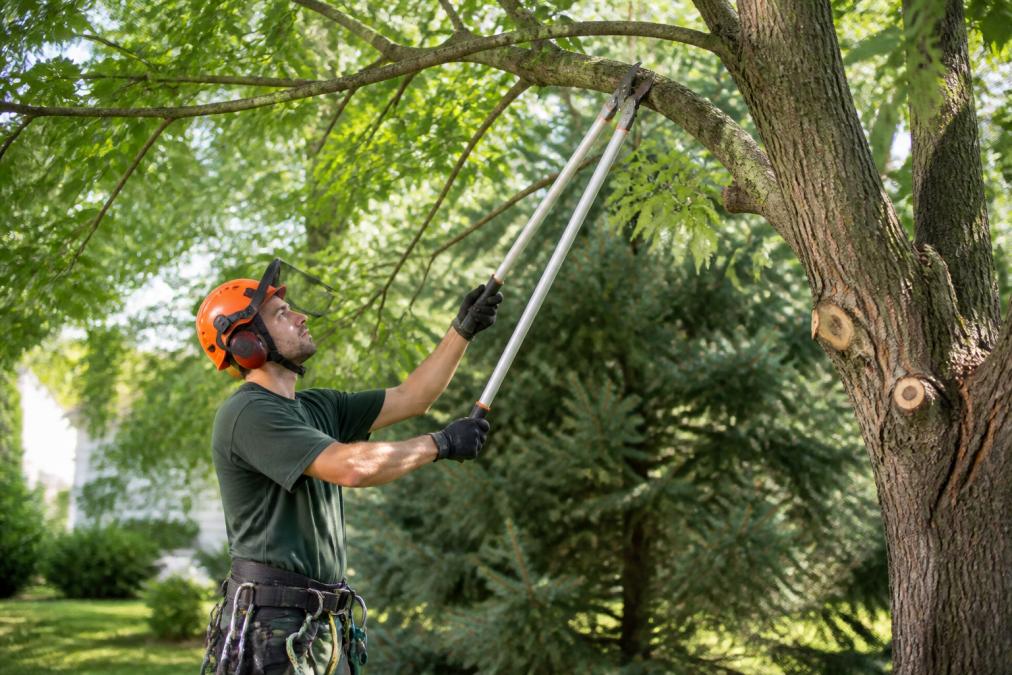
- Pole saw for high branches you can reach from the ground
- Safety gear: helmet, safety glasses, work gloves, and slip-resistant boots
How to Identify Dead, Diseased, and Dangerous Branches
Dead and diseased branches are easy to spot once you know the signs. Check for these clues before you cut:
- No leaves during the growing season
- Brittle bark that flakes off when you scrape it
- Fungal growth like mushrooms near the base
- Hollow or cracked wood
- Branches crossing or rubbing against each other
The Three-Cut Method: Clean Cuts That Protect Tree Health
The three-cut method removes a branch without tearing bark off the trunk. It works on any limb heavier than a few pounds.
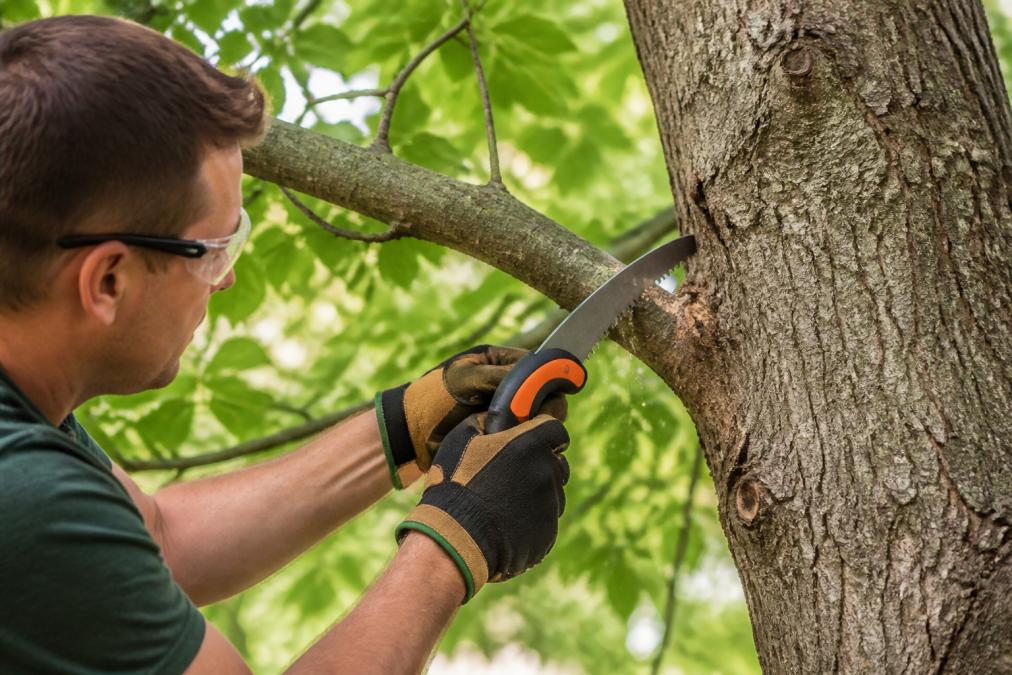
Here is how it works, step by step:
- First cut (undercut): Saw about 30 cm out from the trunk, cutting upward a quarter of the way through the branch.
- Second cut (top cut): Saw down from the top, a few centimeters past the first cut, until the branch drops.
- Third cut (final cut): Remove the stub just outside the branch collar, the swollen ring where the branch meets the trunk.
OSHA Tree Trimming Safety Standards and Power Line Hazards
Power lines are the biggest hazard in residential tree work. OSHA treats any work within 3 meters of energized lines as high-risk and requires trained, qualified workers. For homeowners, the rule is simpler: stay back and call the utility.
Other safety basics worth following:
- Wear PPE every time, even for small jobs
- Keep both feet on the ground
- Never cut alone; have someone nearby
- Sanitize tools between trees to stop disease transmission
Common Tree Pruning Mistakes to Avoid
Most bad pruning comes down to a few repeat offenses. Skip these:
- Topping: cutting the main leader back to a stub. It removes the tree's food-producing canopy, forces it to spend stored energy on water sprouts, and leaves large wounds that decay can enter. Topped trees rarely recover their original form.
- Flush cuts that remove the branch collar. The collar is the tree's built-in seal; cut into it and the wound cannot close.
- Leaving stubs that die back into the trunk and become entry points for rot.
- Over-pruning, which stresses the tree and spurs water sprouts along the remaining limbs.
- Trimming in the wrong season, which can spread disease or remove next year's flowers.
- Dull or dirty tools, which crush tissue instead of slicing it and can transfer pathogens from one tree to the next.
Aim to remove no more than a quarter of the live canopy in a single year. Structural pruning for young trees should focus on lateral branches and the terminal bud, not on cutting back the whole crown.
Finding the Branch Collar
The branch collar is the swollen ring of tissue where the branch meets the trunk or parent limb. It is not always obvious on thin-barked species, but you can usually feel it as a raised ridge with your thumb. The correct cut passes just outside that ridge, leaving the collar intact. A perfect circle of trunk wood means you cut too close; a stub of branch wood means you cut too far.
Tool Care: Sharpening and Sanitizing
A dull blade tears wood fibers instead of slicing them, leaving a ragged wound that seals slowly. Sharpen bypass pruners with a diamond file or stone, following the original bevel angle, usually 20 to 25 degrees. A few strokes on the flat side remove the burr. Touch up pruners every few hours of use and replace blades when nicks are too deep to file out.
After the Cut: Monitoring and Post-Trimming Care
Most guides stop at the cut. The weeks after matter just as much.
- Watch for sunscald. Removing canopy that shaded a trunk or limb exposes previously protected bark to direct sun, which can crack and peel. If you removed a large limb on the south or west side, monitor that area through the following summer.
- Watch for pests at the wound. Fresh cuts attract borers and some beetles. If you see frass (sawdust-like material), sap weeping, or small entry holes around a cut, that is a signal to call an arborist.
- Watch for water sprouts. A flush of fast, vertical shoots below a cut usually means the tree is over-pruned or the cut was too far from the collar. Leave them for a season; many die back on their own, and removing them immediately triggers more.
- Do not paint or seal wounds. Decades of research show wound dressings trap moisture and slow the tree's own compartmentalization. Let the cut air-dry and seal naturally.
- Water and mulch, don't fertilize. A pruned tree is under stress. Keep the soil evenly moist and maintain a 2- to 3-inch mulch ring, but skip high-nitrogen fertilizer for the first season, it pushes soft growth the tree cannot support.
Disposing of Trimmings
Brush piles are a fire and pest hazard if they sit. Your options:
- Chip and mulch. A chipper shredder turns small limbs into mulch you can spread under the same tree or in garden beds. Fresh chips should age a few weeks before use to avoid nitrogen tie-up in soil.
- Municipal green waste. Most cities and counties run yard-waste drop-off or curbside pickup. Check your local solid waste department for accepted sizes and whether diseased material is restricted.
- Compost. Small branches and leaves compost well in a hot pile. Diseased material should generally be bagged and sent to municipal waste rather than composted at home, since home piles rarely reach the temperatures needed to kill pathogens.
- Leave the habitat. A small brush pile in a back corner of the yard provides cover for birds and pollinators. Keep it away from the house and any structures.
When to Hire Professional Tree Trimming Services
Call a professional when the job involves height, power lines, or heavy limbs. Those three factors turn a weekend chore into a serious risk.
Hire a pro if:
- Any branch is within 3 meters of a power line
- The limb is larger than 15 cm in diameter
- The tree is leaning or has visible cracks
- You need to work above 3 meters off the ground
- The tree shows signs of disease across the whole canopy
Timing: The Dormant-Season Window
For most deciduous trees, the safest window is late dormancy, after leaves drop but before buds swell in spring, usually between late fall and early spring. The tree is not actively pushing new growth, its vascular system is largely shut down, and the fungal and insect vectors that colonize fresh wounds are less active in cold weather. A February cut typically seals with wound wood faster than the same cut in June.
There are important exceptions:
- Spring-flowering trees (dogwood, lilac, forsythia, flowering cherry) should be pruned right after they bloom. Pruning in late winter removes the buds that would have flowered that year.
- Maples, birches, walnuts, and elms are "bleeders." Prune them in late summer or early fall, not late winter, to avoid heavy sap flow from the cuts.
- Oaks should not be pruned between roughly April and July in regions where oak wilt is present, because sap-feeding beetles that carry the fungus are most active then. Your state extension office publishes the exact date window for your area.
- Evergreens with needle foliage are most forgiving in early spring, just before new growth flushes.
Young vs. Mature Trees
A young tree needs structural pruning, not size reduction. The goal is one dominant leader and well-spaced scaffold branches that will carry the canopy for decades. Start structural pruning the second or third year after planting and repeat every two to three years.
What to Ask Before You Hire
- Credentials: Ask for an ISA Certified Arborist on staff. Certification is issued by the International Society of Arboriculture and requires passing an exam plus continuing education.
- Insurance: Ask for a certificate of insurance showing both general liability and workers' compensation. If a crew member is injured on your property without workers' comp, the claim can land on your homeowner's policy.
- Quote in writing: The quote should list what is removed, what is left, who handles the debris, and whether stump grinding is included.
- Disposal: Confirm up front whether the crew chips and hauls the brush or leaves it on site. Many homeowners prefer to keep the chips for mulch.
Timing is not a detail, it is the single biggest factor a homeowner controls. Prune in the right window for the species, remove no more than a quarter of the live canopy per year, and hire a certified, insured crew for anything above head height or near a line.
Conclusion
Safe tree trimming is about knowing your limits. Small branches, sharp bypass pruners, and a solid stance on the ground are all most homeowners need. Everything else, especially anything near power lines or above head height, belongs to a trained crew.
Frequently Asked Questions
What is the 1-2-3 rule for pruning trees?
The 1-2-3 rule refers to the three-cut method for removing larger branches. First, make an undercut about 12 to 15 inches from the trunk, cutting one-third through the branch from below. Second, make a top cut just outside the undercut until the branch falls. Third, cut the remaining stub back to the branch collar. This sequence prevents the bark from tearing down the trunk, which protects the cambium layer and helps the tree seal the wound with wound wood.
What months should you not trim trees?
Avoid heavy pruning in spring when buds are opening and in early fall. Spring cuts can bleed sap and stress trees during active growth, while fall pruning may stimulate new growth that won't harden before frost. Oak trees in particular should not be pruned from April through July in many states because of oak wilt risk. The dormant season, typically late winter, is the safest window for most structural pruning.
What are the OSHA safety guidelines for tree trimming?
OSHA 1910.269 and 1910.266 cover tree trimming work, requiring employers to keep workers at least 10 feet from energized power lines unless they are qualified. Personal protective equipment including head, eye, and hand protection is mandatory. Chainsaw operators must wear leg protection. While these OSHA tree trimming safety standards apply to paid workers, homeowners should follow the same rules: never trim near power lines and always wear gloves, eye protection, and a hard hat.
When is it time to call a professional for tree trimming?
Call a professional when branches are within 10 feet of power lines, when a tree is taller than 15 to 20 feet, when limbs overhang your roof or a neighbor's property, or when you spot signs of disease like fungal growth or hollow trunks. Homeowners in Central New Jersey can request a free estimate from QEN Landscaping to assess whether a tree needs professional care or can be safely handled with basic tools.