 How-to
How to Plan Professional Grounds Maintenance for HOA Communities
Last Updated: November 12, 2026
Quick Summary
Professional grounds maintenance for HOA communities is the contracted care of shared lawns, trees, beds, and irrigation across common areas, delivered on a fixed schedule by a single accountable crew. It replaces scattered volunteer effort and one-off hires with predictable service and documented results.
- Build a one-page scope matrix so bids with different services can be compared fairly.
- Score bids on a 100-point scale, weighting scope completeness and staffing highest and price lowest.
- Set measurable standards such as turf height of 3 to 4 inches and leaks repaired within 48 hours.
- Audit irrigation zone by zone first, then track monthly water use to catch spikes early.
- Write staged drought-response plans into the guidelines so the board can act without emergency meetings.
Table of Contents
- Why HOA Communities Are Switching to Professional Grounds Maintenance
- Building an HOA Landscape Maintenance Schedule That Works Year-Round
- HOA Lawn Maintenance Guidelines Every Board Should Adopt
- HOA Landscape Committee Guidelines for Vendor Selection and Bids
- The Commercial Landscape Maintenance Checklist for Common Areas
- Water Conservation and Climate-Resilient Landscaping for HOAs
- Requesting a Free Estimate for Your Community's Grounds Care
- Frequently Asked Questions
Why HOA Communities Are Switching to Professional Grounds Maintenance
Professional grounds maintenance for HOA communities is the contracted care of shared lawns, trees, beds, and irrigation across common areas, delivered on a fixed schedule by a single accountable crew. It replaces scattered volunteer effort and one-off hires with predictable service and documented results.
The pressure to switch is real. Roughly 53% of American homeowners live in HOA communities, according to iPropertyManagement's HOA statistics, and boards hear about landscaping more than almost any other line item. Demand for grounds workers reflects that: the U.S. Bureau of Labor Statistics projects 5% growth in grounds maintenance employment from 2025 to 2035, faster than the average for all occupations.
At QEN Landscaping, we have more than 15 years of experience serving residential and commercial clients. Below, we break down the schedule, standards, vendor process, and contract safeguards that help outsourced care work well.
What Professional Grounds Maintenance Covers in Shared Spaces
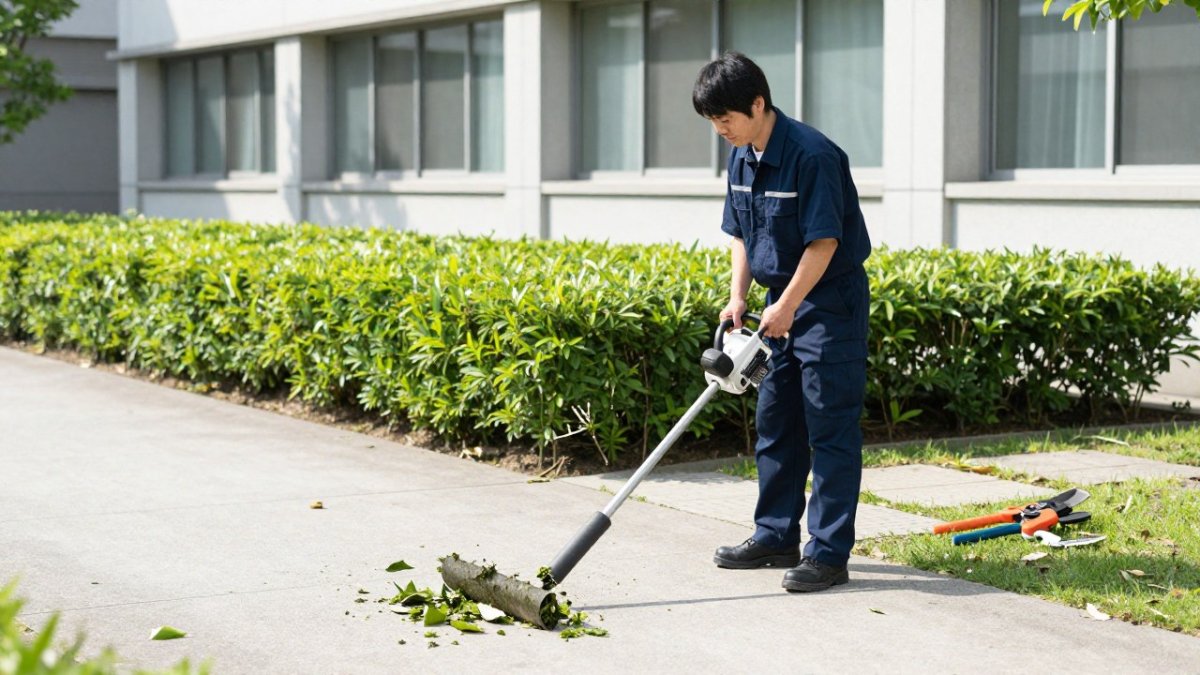
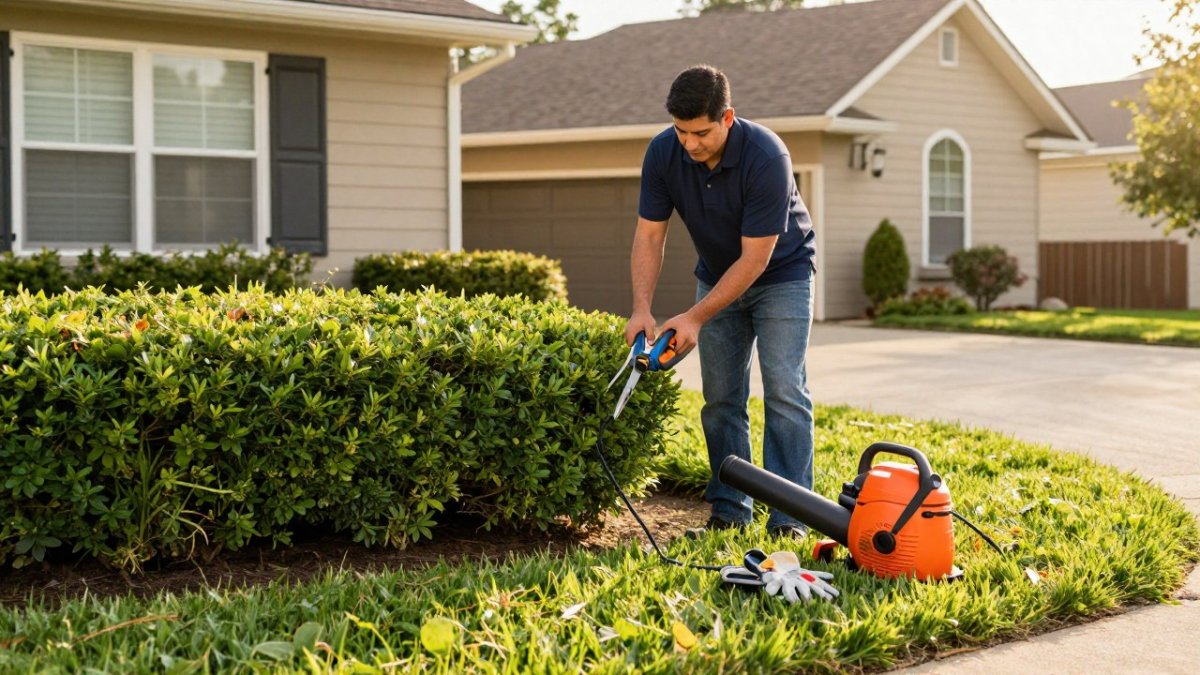
A full-service contract covers mowing, edging, trimming, pruning, weed control, fertilization, irrigation checks, and seasonal cleanup across common areas. The scope should be written down line by line, not implied.
- Turf care: mowing at a consistent height, edging walks and curbs, string trimming around posts and beds
- Tree and shrub care: structural pruning, shaping, and removal of deadwood
- Weed and pest management: bed weeding, pre-emergent timing, and scouting for disease
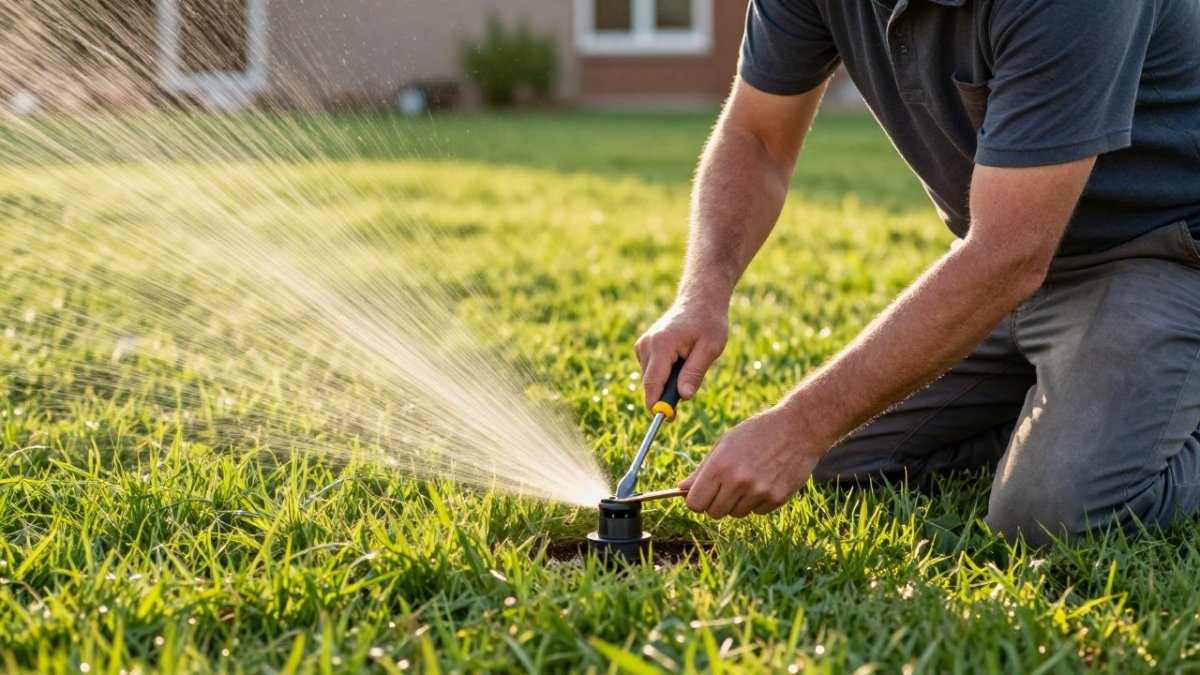
- Irrigation: seasonal start-up, zone checks, head adjustments, and winterization
- Seasonal work: spring mulch, fall leaf removal, and storm cleanup
What most guides miss is that shared spaces fail at the edges. Mulch lines, curb joints, and mailbox islands are common sources of complaints, so it helps to put them in the scope explicitly.
Building an HOA Landscape Maintenance Schedule That Works Year-Round
A workable HOA landscape maintenance schedule follows the growing season, not the calendar month. Spring covers cleanup, mulch, and irrigation start-up. Summer is mow-and-monitor season. Fall handles leaves, aeration, and overseeding. Winter means pruning and equipment prep.
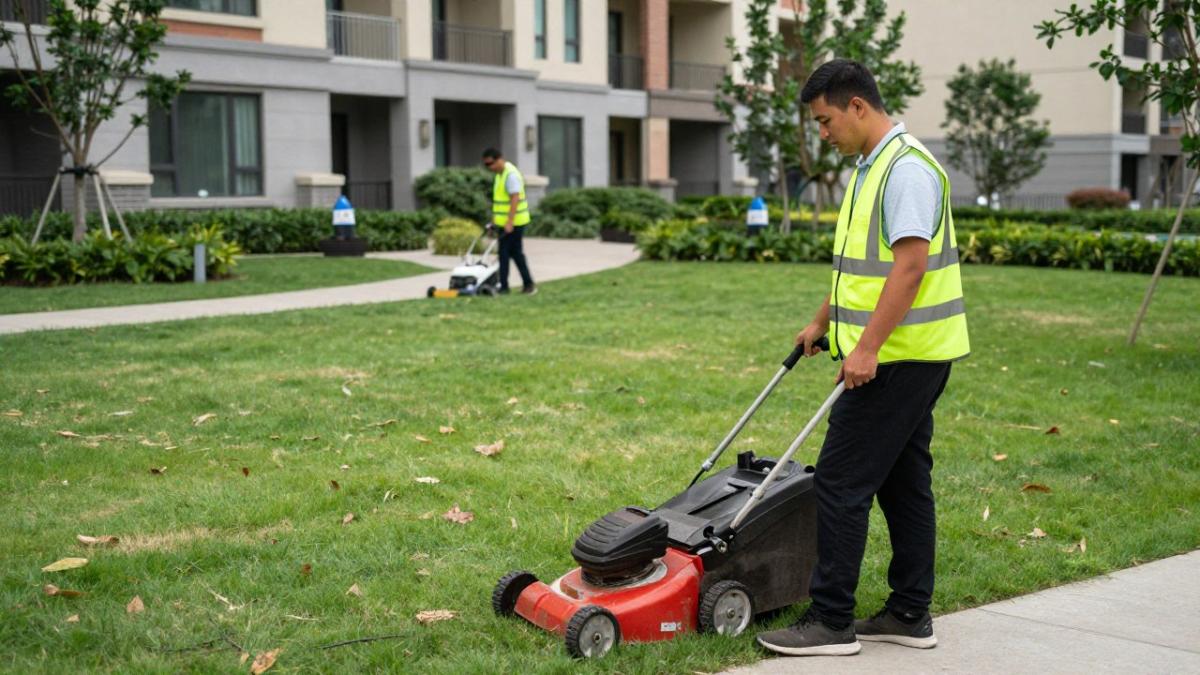
Frequency matters more than any single visit. Ask every bidder to state visit frequency in writing, then hold them to it.
Watch out: a contract that says "as needed" for mowing is how lawns end up shaggy in July. Specify a maximum grass height and a response window instead.
HOA Lawn Maintenance Guidelines Every Board Should Adopt
HOA lawn maintenance guidelines should set measurable standards: grass height ranges, edging depth, bed weed tolerance, and response times for complaints. Vague language like "well-maintained" gives a contractor nothing to hit and gives residents nothing to point to.
Adopt a short written standard and attach it to the contract. A practical baseline might include:
| Standard | Target | Check Frequency |
|---|---|---|
| Turf height | 3 to 4 inches, never above 5 | Weekly in season |
| Edging | Clean line at walks and curbs | Every visit |
| Bed weeds | Under 10% visible coverage | Biweekly |
| Irrigation leaks | Repaired within 48 hours | Monthly inspection |
| Complaint response | Acknowledged in 1 business day | Ongoing |
These numbers give the board something to inspect and the contractor something to defend. They also make renewal decisions far less emotional.
HOA Landscape Committee Guidelines for Vendor Selection and Bids
Strong HOA landscape committee guidelines turn bid review into a scoring exercise instead of a popularity contest. Require three written bids, score them against the same weighted criteria, and document why the winner won, because the losing bidders and the residents who favored them will ask.
Step 1: Normalize the scope before you compare dollars
A common mistake is comparing bottom-line prices across bids with different scopes. One quote may include irrigation checks and another may not, so the numbers are not comparable. Build a one-page scope matrix listing every service the community needs, mowing frequency, edging, bed weeding, pre-emergent timing, shrub pruning, irrigation start-up and winterization, storm cleanup, mulch refresh, and mark whether each bidder includes it, excludes it, or prices it as an add-on. Only then compare totals.
Step 2: Score on weighted criteria
Use a 100-point scale the board can defend at the annual meeting:
| Criterion | Weight | What to verify |
|---|---|---|
| Scope completeness | 25 | Every matrix line item addressed in writing |
| Visit frequency and staffing | 20 | Crew size, visits per month by season, assigned account manager |
| Insurance and licensing | 15 | General liability, workers' comp, state pesticide applicator license where required |
| References from comparable communities | 15 | At least two HOAs of similar acreage and site complexity |
| Communication and reporting | 15 | Named contact, work-order system, photo documentation cadence |
| Price | 10 | Normalized total, not the headline number |
Weight
Weight scope and staffing highest because those drive outcomes; price is the tiebreaker, not the driver. A cheap bid with a vague scope is the most expensive option on the table once rework and complaints are counted.
Step 3: Verify insurance, licensing, and references
Ask any contractor for a certificate of insurance naming the association as additional insured, and confirm workers' compensation coverage. Where state law requires a pesticide applicator license for weed and pest work, confirm the license number. Call references and ask three questions: How often did the crew actually show up? How fast were complaints acknowledged? Would you renew at the same price?
Step 4: Put service levels and safeguards in the contract
A bid becomes enforceable only when the contract defines visit frequency, response times, exclusions, change-order pricing, reporting, and remedies. Specify a maximum grass height and a response window instead of "as needed." Include a cure period for missed visits, a defined process for approving extra work (so add-on invoices do not appear unannounced), and a termination clause tied to repeated service-level failures. Attach the board's written maintenance standard as an exhibit so the contractor is measured against the same document residents see.
Watch out: a contract that names a price but not a visit count per month leaves the board with no leverage when crews skip shoulder-season weeks.
The Commercial Landscape Maintenance Checklist for Common Areas
A commercial landscape maintenance checklist keeps inspections consistent from month to month. Walk the property with the same list every time and note what failed, not just what looks fine.
- Turf cut at the specified height, no scalping at corners
- Edges clean along walks, curbs, and islands
- Beds weed-free and mulch at proper depth
- Shrubs shaped, deadwood removed
- Irrigation running with no broken heads or dry zones
- Trash and clippings removed from site
- Storm damage reported with photos
Boards that inspect against a written list catch small problems before they become assessments. It also gives the contractor a fair record of what was actually observed.
Water Conservation and Climate-Resilient Landscaping for HOAs
Water conservation starts with measurement, not with cutting watering to the point of brown turf. A zone-by-zone irrigation audit finds leaks, misaligned heads, and overspray before they run up the water bill, and it gives the board a baseline to prove savings later.
Audit first, then set targets
Walk every zone with the contractor and record: operating pressure, head-to-head coverage, overspray onto pavement, broken or tilted heads, and run times per zone. A single audit can surface several low-cost fixes, swapped nozzles, adjusted arc, repaired leaks, that may pay back within a season. Set a board-level target such as reducing irrigation runtime per zone by a defined percentage after the audit, and track it monthly against the water bill.
Smart irrigation and water-use monitoring
Weather-based or soil-moisture controllers adjust run times to actual evapotranspiration instead of a fixed clock, which is where most overspending happens. Pair the controller with monthly meter reads and a leak-response standard, for example, leaks repaired within 48 hours of detection. Require the contractor to report water use per zone each month so the board can spot a spike before it becomes a three-figure bill.
Plant selection and hydrozoning
Replace thirsty ornamentals in hell strips and island beds with native or regionally adapted, drought-tolerant shrubs. Group plants by water need, hydrozoning, so one zone does not soak a dry-lover's roots. Add mulch to reduce evaporation, keep mower blades sharp to reduce turf stress, and consider converting low-traffic turf triangles to beds or groundcover where mowing is difficult and irrigation is wasteful.
A drought-response plan the board can trigger
Write a staged plan into the guidelines: Stage 1 reduces runtime on non-essential zones; Stage 2 prioritizes trees and newly installed plants over turf; Stage 3 suspends overseeding and limits watering to establishment and tree survival. Having the stages pre-approved avoids emergency board meetings when restrictions arrive.
Research from the University of Florida IFAS Extension on pollinator gardening in HOA communities found residents face both real and perceived barriers to sustainable planting, and many are unsure what their rules allow. Boards can remove that uncertainty by writing climate-friendly planting and drought stages into the guidelines, then communicating them to residents before the dry season.
Watch out: a drought plan that cuts water uniformly across all zones stresses trees and newly planted beds first, prioritize establishment and canopy over turf.
Requesting a Free Estimate for Your Community's Grounds Care
A useful first step toward consistent grounds care is to put the scope, schedule, and standards in front of a contractor who will commit to them in writing.
QEN Landscaping serves HOAs, property managers, and commercial sites with customized solutions, top-quality materials, and constant communication until the job is done. QEN Landscaping works with residential and commercial clients and offers customized solutions with constant communication until the job is done.
For boards weighing professional lawn maintenance services, our guide to what professional lawn maintenance services include covers scope and cost drivers before you commit. Then request a free estimate and get your community on a schedule that holds.
Your board should not have to chase a crew to find out why the beds look rough. QEN Landscaping brings over 15 years of experience, tailored solutions for each property, and communication that continues until the work is finished.
Frequently Asked Questions
What should an HOA grounds maintenance plan include?
A workable plan names every service and how often it happens: mowing and edging, trimming, pruning, weed control, fertilization, irrigation checks, seasonal cleanups, and pest and disease response. It should also set measurable standards, such as lawn height and response times for resident complaints. Keep the plan written down and reviewed each year.
How often should an HOA schedule landscaping services?
Most communities need mowing and edging weekly during the growing season and less often in cooler months, with pruning, fertilization, and irrigation checks on a separate calendar. Your HOA landscape maintenance schedule should list each task with a frequency and a season, not just a monthly visit count. Boards should also build in extra visits after storms and before community events. Review the schedule each year against actual service reports so the contract matches what the property really needs.
What should an HOA look for in a professional grounds maintenance company?
Look for a written scope of work, proof of insurance, clear response times, and a single point of contact who answers calls. Ask how the company handles resident complaints and whether it provides service reports after each visit. QEN Landscaping, for example, has served residential and commercial clients for over 15 years. Compare at least three bids on the same scope before deciding.
How can an HOA handle resident complaints about landscaping?
Set up a simple reporting path: residents submit concerns to the board or manager, who logs them and forwards them to the contractor with a deadline. Track how quickly each issue is resolved and review the log at board meetings. Most complaints trace back to unclear standards, so publish your HOA lawn maintenance guidelines and let residents see what is scheduled. A contractor who confirms receipt and reports back on each fix removes most of the friction before it reaches the board.