 How-to
How Long Does Sprinkler Repair Take on Average?
Last Updated: November 1, 2026
Quick Summary
Most common sprinkler repair jobs take two hours or less of hands-on work, according to LawnStarter's 2026 sprinkler repair cost guide. The full appointment usually runs 1.5 to 3.5 hours once you add diagnosis, testing, and cleanup. Mainline breaks are the slowest repair, taking 3 to 6 hours.
- Hands-on repair often runs 30 minutes to 2 hours, with diagnosis adding 15 to 45 minutes.
- Sprinkler head replacement takes 30 to 60 minutes, the quickest job on the list.
- Valve replacement typically takes 1 to 2.5 hours, including shutoff, digging, and testing.
- Buried valve boxes or poor access can add 30 to 90 minutes to the appointment.
- Five or more heads across several zones start to look like a half-day job.
Table of Contents
- How Long Sprinkler Repair Takes on Average
- Average Repair Time by Component and Repair Type
- Sprinkler Head Replacement Time: What to Expect
- Sprinkler System Leak Repair: Finding the Source First
- Sprinkler System Troubleshooting: Valves, Wiring, and Controllers
- What Factors Change How Long a Repair Takes
- Sprinkler Repair Cost: Why Time and Price Move Together
- How to Prepare Before the Technician Arrives
- Frequently Asked Questions
How Long Sprinkler Repair Takes on Average
Most common sprinkler repairs take two hours or less for a professional to finish, according to LawnStarter's 2026 sprinkler repair cost guide. That number covers the hands-on work only. The full visit, from driveway to driveway, usually runs longer.
At QEN Landscaping, we have served Central New Jersey for over 15 years. The repair itself is often quick, and diagnosis can take the most time.
So how long does sprinkler repair take on average? Expect the time to vary with the problem. A buried leak or a wiring fault can take considerably longer than a standard fix.
Below, we break down repair times by component, explain what stretches a job, and show you how to cut your appointment time before we arrive.
Hands-On Repair Time vs. Total Appointment Time
Two clocks run during every service call. The first is repair time: the minutes a technician spends with tools in hand. The second is appointment time: the whole visit, including diagnosis, testing, and cleanup.
- Hands-on repair: often 30 minutes to 2 hours
- Diagnosis and system inspection: 15 to 45 minutes
- Testing and zone checks after the fix: 10 to 20 minutes
- Total appointment: typically 1.5 to 3.5 hours
Average Repair Time by Component and Repair Type
Repair time depends less on the symptom and more on the part. Here is how the common jobs stack up.
| Repair Type | Typical Hands-On Time | Why It Takes That Long |
|---|---|---|
| Sprinkler head replacement | 30-60 minutes | Dig out the old head, swap it, reseat the soil |
| Leak repair at a fitting | 1-2 hours | Locate the leak, cut and rejoin the pipe |
| Valve replacement | 1-2.5 hours | Shut off water, dig out the box, swap and test |
| Controller replacement | 45-90 minutes | Rewire, remount, reprogram zones |
| Wiring fault repair | 1-3 hours | Trace the fault, splice, test each zone |
| Mainline break | 3-6 hours | Excavation, pipe repair, pressure testing |
Head swaps are the quickest job on the list. Mainline breaks are the slowest, because the pipe sits deeper and the repair needs a longer test cycle.
Sprinkler Head Replacement Time: What to Expect
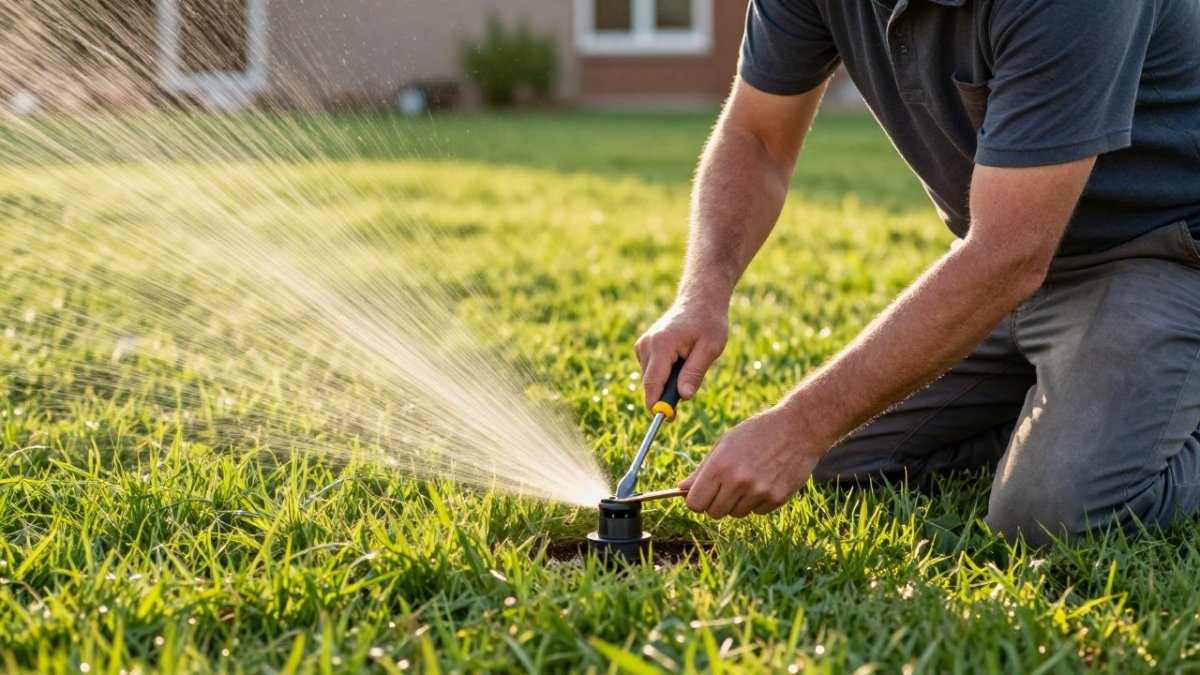
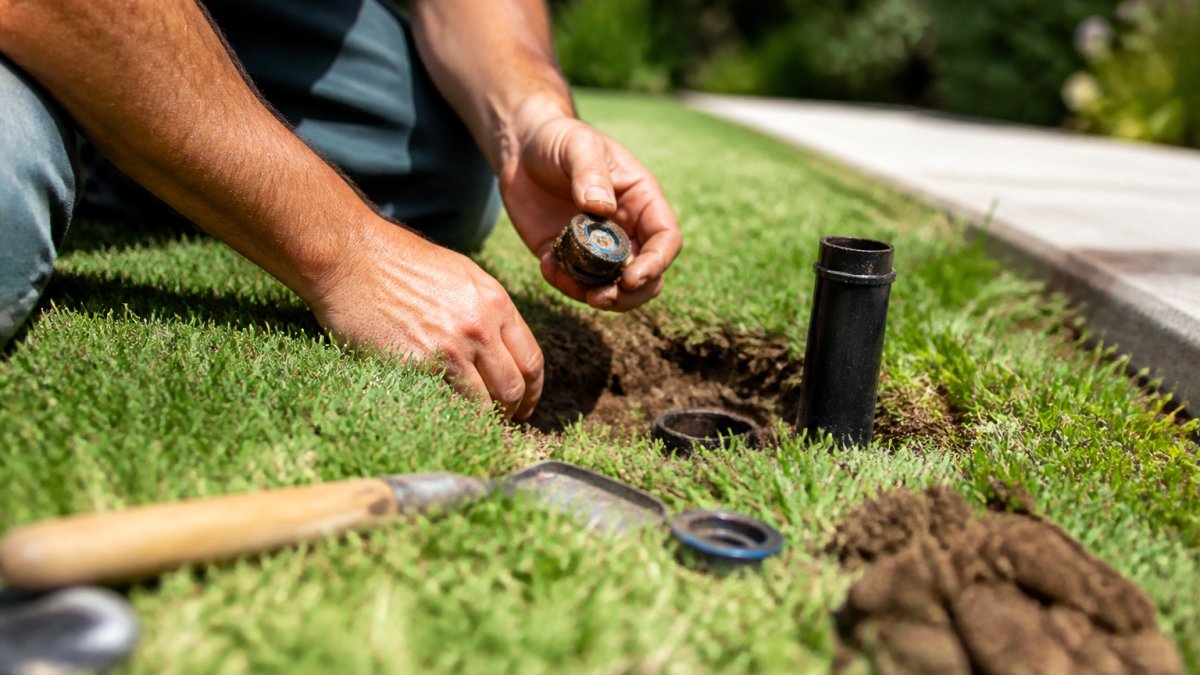
Replacing a sprinkler head takes one hour or less, and many single-head swaps finish in about 30 minutes. That estimate comes from LawnStarter's repair-time breakdown, and it matches what we see on routine calls.
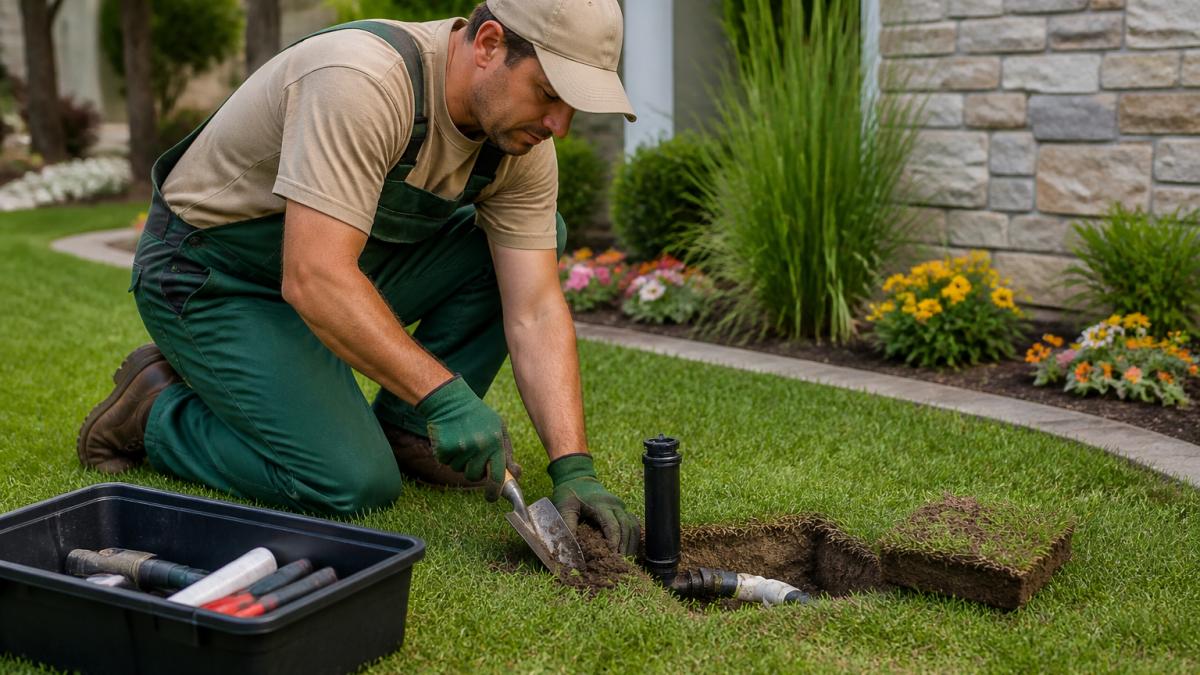
The job moves fast when three things line up:
- The replacement head is the same model and pop-up height
- The fitting below the head is intact
- The soil around the head is soft, not compacted
A broken head near a driveway edge or under a shrub slows things down. So does a mismatched replacement. If the new head sprays a different pattern, the technician has to adjust or swap it again, and that adds time.
One head is a quick visit. Five or more heads across several zones start to look like a half-day job.
Sprinkler System Leak Repair: Finding the Source First
Sprinkler system leak repair follows a simple order: check the water meter, watch each zone run, then dig where the ground stays wet. A leak at a visible fitting is quick work. A leak under a patio, a walkway, or a mature tree root is not.
Watch out: a leak that soaks the soil near your foundation does more than waste water. It can soften the ground under hardscaping and stain siding. If you see a constant wet patch that never dries, call before the next rain.
Sprinkler System Troubleshooting: Valves, Wiring, and Controllers
Sprinkler system troubleshooting is the diagnosis phase, and it is where most of the clock disappears. A valve that won't open, a zone that won't shut off, and a controller that skips stations can all produce the same symptom: dry grass.
Here is how the common faults break down:
What Factors Change How Long a Repair Takes
Most competitors list a handful of variables and stop there. A more useful approach is to treat the estimate like a checklist: start with a base time for the repair type, then add or subtract minutes for each condition the technician will actually encounter. That is how a two-hour job becomes a four-hour job, and it is the framework below.
The estimate framework: base time plus modifiers
Start with the base hands-on time from the repair-type table earlier in this article. Then apply the modifiers that match your property. The result is a realistic range, not a guess.
| Factor | What It Looks Like | Typical Time Impact |
|---|---|---|
| Access to the component | Valve box under a deck, behind shrubs, or beneath a paver patio | Add 30-90 minutes for digging, moving obstacles, and cleanup |
| Soil conditions | Compacted clay, rocky fill, or root-bound soil | Add 15-45 minutes; clay and roots slow excavation and re-seating |
| Number of damaged zones | One dry zone versus three zones with different symptoms | Add 20-40 minutes per additional zone for testing |
| Parts availability | Exact replacement head, solenoid, or controller not on the truck | Add 30-60 minutes for a supply-house run, or reschedule |
| System age and type | Older galvanized or poly fittings; commercial system with many zones | Add 15-60 minutes for fragile fittings and longer test cycles |
| Repair complexity | Simple component swap versus mainline break or buried wiring fault | Base time can double or triple |
How to read the modifiers
A valve replacement is a good example of how modifiers stack. Base time is one to two and a half hours. If the valve box is buried under mulch and the solenoid is seized, add 30 to 45 minutes. If the replacement solenoid is not on the truck, add a supply run. That is how a "quick valve job" becomes a half-day appointment.
Factors that do not change repair time much
Some variables homeowners worry about rarely move the clock. The brand of controller, the color of the heads, and the size of the lawn matter far less than access, soil, and parts. A large property with easy access and the right parts on the truck can finish faster than a small property with a buried valve box and a mystery wiring fault.
When to expect a longer appointment
If you are weighing a one-off repair against ongoing care, our Professional Lawn Maintenance Services NJ: 2026 Guide covers the broader maintenance offering you can book.
Sprinkler Repair Cost: Why Time and Price Move Together
Sprinkler repair cost is influenced by labor and time. The mechanism matters if you want to compare quotes. Most irrigation companies use one of two billing models, and each one turns time into price differently.
The two billing models
Ask which model applies before you book. A flat-rate quote for a head swap and an hourly quote for the same job can land in very different places once the appointment runs long.
Translating a time estimate into a price expectation
A common pattern is that the diagnosis portion of the visit is billed at the same hourly rate as the repair. That is why a job that turns out to be a loose wire can still carry a meaningful service call fee: the technician spent time finding the fault, even if the fix took ten minutes.
What drives the parts portion
The parts line is usually smaller than the labor line for common repairs, but it varies. A standard pop-up head, a solenoid, and a controller are commodity items with a narrow price band. A mainline repair can require pipe, fittings, and sometimes a section of replacement line, which adds to both the parts cost and the time.
Why time and price diverge across companies
Two companies can quote the same repair at different prices because their hourly rates differ, their service call fees differ, and their flat-rate cushions differ. The U.S. Bureau of Labor Statistics occupational outlook for landscaping and groundskeeping notes that demand for grounds maintenance work keeps growing, which is worth knowing when you compare labor rates across companies. Higher demand in a tight labor market tends to push hourly rates up, not down.
Pricing depends on the repair, the parts, and the access. For current pricing or a quote, request a free estimate through the QEN Landscaping website.
How to Prepare Before the Technician Arrives
A little prep shortens the visit. Do these five things before the truck pulls in:
Frequently Asked Questions
Can a sprinkler system be repaired in one visit?
Most common issues can be fixed in a single visit. Many common issues can be fixed in a single visit, though jobs that need trenching, locating a buried leak, or ordering a specialty part may require a second appointment. Ask about parts availability when you book.
How long does it take to find and repair an underground sprinkler leak?
Locating the leak is usually the slow part. An underground pipe leak may need line tracing, zone-by-zone testing, and a small excavation before the repair starts, so the full appointment can run longer than a head swap. Ask about any diagnostic or service call fee before work begins.
What makes sprinkler repair cost more than the repair time suggests?
Labor rate, parts, system type, and access all affect the final bill. A repair that takes 30 minutes can still cost more if it requires a specialty valve, a controller replacement, or digging through established landscaping. Property size and the number of zones also add time and labor. Because pricing varies by job, request a free estimate through the QEN Landscaping website to see current pricing.
How long should a sprinkler system last before repairs become frequent?
Repair frequency climbs as a system ages, and the supplied research does not give a verified lifespan figure, so treat any single number with caution. What matters more is the pattern: repeated leaks in the same zone, valves that fail season after season, or heads that keep breaking often point to a system nearing replacement rather than another round of sprinkler system troubleshooting.
Irrigation problems rarely fix themselves, and a small leak today becomes a water bill and a soggy lawn next month. QEN Landscaping brings over 15 years of experience to every irrigation call, serving both residential and commercial clients with customized solutions and constant communication until the job is done. We diagnose first, quote clearly, and use top-quality materials on every repair. Get started with QEN Landscaping and request a free estimate for your sprinkler system today.